THE NATURE CONSERVANCY (TNC)
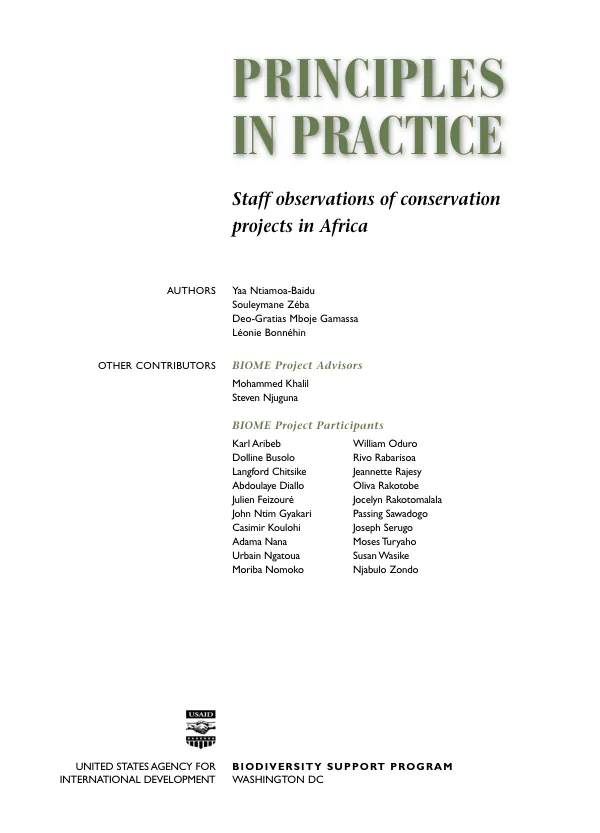
Principles in practice : staff observations of conservation projects in Africa
This book describes and presents field-based lessons from 11 conservation projects undertaken in Africa and Madagascar under the Biodiversity Monitoring and Evaluation (BIOME) program.
Ntiamoa-Baidu, Yaa; Zeba, Souleymane · 1970
Sign in to readA free account is required to download.
Abstract
The projects, which represent a range of biophysical, cultural, political, institutional, and economic contexts and conservation approaches, are: (1) Communal Areas Management Program for Indigenous Resources (CAMPFIRE), Zimbabwe; (2) Participation of Local Communities in the Conservation of Kabore Tambi National Park (NATURAMA), Burkina Faso; (3) Dzanga-Sangha Integrated Conservation and Development, Central African Republic; (4) Indigenous Vegetable and Fruit Tree Development Project (KENGO), Kenya; (5) Masoala Peninsula Integrated Conservation and Development, Madagascar; (6) Lake Mburo National Park Community Conservation, Uganda; (7) Living in a Finite Environment (LIFE), Namibia; (8) Madagascar Fish Eagle and Wetlands Conservation, Madagascar; (9) Research on Multiple-use Plant Species in the Boucle du Baoule Biosphere Reserve (AMCFE), Mali; (10) Sacred Grove and Biodiversity Conservation (GACON), Ghana; and (11) Conservation and Sustainable Development around Tai National Park (Vie et Foret), Cote d"Ivoire. The following lessons have been learned about the conservation principles governing these projects: (1) The level, form, and timing of community participation varies with stakeholder capacity and the issues that need to be addressed. The greater the change desired in people"s use of natural resources, the greater the investment that must be made in people"s participation. (2) An enabling policy environment is a key to successful biodiversity conservation, and project staff play a central role in helping governments formulate and implement new enabling policies. (3) Local knowledge often provides project staff with opportunities for developing effective conservation approaches, but must often be merged with outside tools and approaches to address the challenges of the 21st century. (4) Project staff who can identify convergent values across stakeholder groups find it easier to implement biodiversity conservation projects. This requires understanding the values underpinning their project and actively relating these values to those of other stakeholders. (5) Placing custodianship of, and management responsibility for, critically needed resources in the hands of local communities is a key to meeting people"s needs while conserving biodiversity. Since, however, most rural communities lack the capacity to manage natural resources sustainably, partnerships between local communities and external agencies are often a better option than total devolution of responsibility. (6) Changing stakeholder behavior is a complex process that is influenced by stakeholder knowledge and by social and economic factors. To address the needs of various stakeholders, project staff tend to take a broad-based approach to education. A range of communication tools should be used to target training and awareness raising at particular stakeholders. (7) For communities to invest time and effort into monitoring, project staff need to make it very clear why the information is being collected and how it relates to their own interests. The approach that project staff adopt for monitoring and evaluation should match the capacity of project participants. (8) To build and maintain the institutional and technical capacity needed to sustainably manage natural resources, a stable source of financial support must be available. As few options exist for generating sufficient revenues from the sale of natural resources, long-term external financial support from national accounts and international donors is essential for effective conservation of biodiversity in Africa and Madagascar. Includes references.
Related documents


![Biodiversity support program"s biodiversity conservation network [BCNet] : evaluating an enterprise-oriented approach to community-based conservation in the Asia/Pacific region -- fiscal year 1998 technical report : 1 October 1997-30 September 1998](https://covers.devme.ai/gen/50509.webp)