USAID DEC
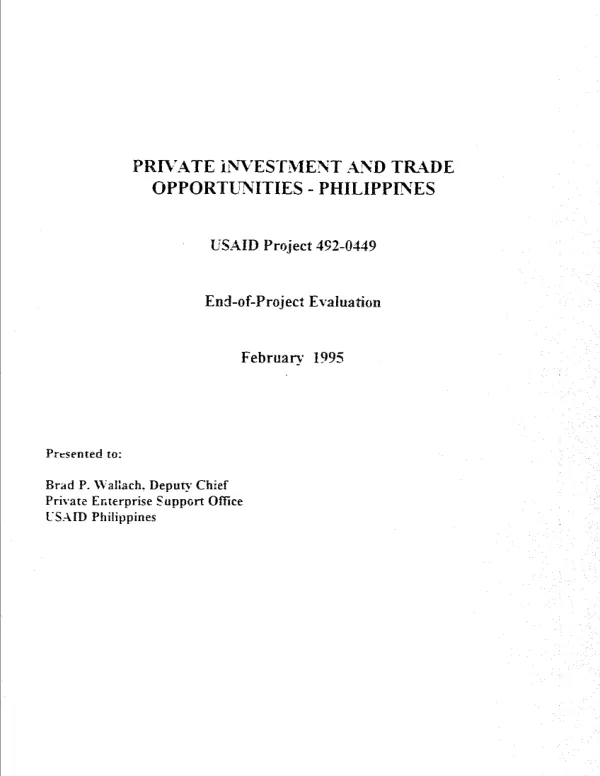
Private investment and trade opportunities - Philippines, USAID project 492-0449 : end-of-project evaluation
Sign inSGV & CO.
Private investment and trade opportunities - Philippines, USAID project 492-0449 : end-of-project evaluation
Final evaluation of a project (1990-94) to establish a mechanism to increase trade and investment in the Philippines through promotional services and assistance, training and TA, and policy analysis and reform.
1995
Sign in to readA free account is required to download.
Abstract
The private sector Philippine Exporters Foundation (PHILEXPORT) was the implementing agency. The project substantially met the output and purpose targets set by the revised logframe. Specifically, it: (1) helped develop local capabilities for managing donor-assisted trade and investment promotion (T&IP) projects; (2) facilitated, through its policy analysis and advocacy efforts, the development of PHILEXPORT as the advocate of exporters in the country; (3) engaged the Project Implementation Committee effectively and productively; and (4) effectively utilized market mechanisms in the delivery of T&IP services. It also introduced the innovative concept of "fee for service" into its trade brokerage and computerized trade information service (CTIS) and the concepts of "cost sharing" and "project reflow" into its T&IP and training and TA components. There were some shortcomings, however. (1) An initial assessment of the real needs of the project areas could have strengthened the sectoral priorities and roles of participating organizations. Such studies should be carried out prior to implementation as opposed to introducing changes in focus midway through implementation. (2) Institution-building should have been an integral part of project implementation; for example, capacity-building programs for project proponents could have enhanced their participation and absorptive capacity. (3) An effective monitoring and evaluation system such as was developed for the trade brokerage component could have been implemented for the training and TA component, and possibly also for the T&IP component. (4) The project was very selective in its outreach and communication efforts, which were addressed only to the project's focus groups/areas; outreach efforts were not very effective in Davao. The following are among the lessons learned. (1) Physical integration of the project management and project grantee would have enhanced interaction and possibly the integration of the activities of both parties. (2) The project had several substantial T&IP elements, including the innovative trade brokerage component and the CTIS. Implementing some of these as separate projects could have focused resources more efficiently and increased the success rate of these elements, though it would have caused bureaucratic complications for USAID. (3) The choice of a private sector organization as the implementing entity freed the project from having to contend with the rules and regulations guiding the operations of government agencies. (4) The project tapped and networked with local resources for project implementation, contributing to the development of local expertise and competencies in T&IP project management. (5) The Policy Research and Advocacy Facility (PRAF) gave PHILEXPORT adequate elbow room to undertake policy research and advocacy activities. Project grantees are usually more enthusiastic when given the flexibility to undertake activities on their own. (6) Close coordination among participating organizations (including government entities) was a critical factor in project implementation. (7) Industry associations must cover increasing cost-share and remit decreasing project reflows, leading eventually to full cost-recovery or fee-for-service.
Related documents
Documents in this collection
 1995
1995USAID DEC
Private investment and trade opportunities - Philippines, USAID project 492-0449 : end-of-project evaluation
Open record 2020
2020USAID DEC