CAPRICORN AFRICA ECONOMIC ASSOCIATES
Private sector and the economy of Swaziland
In Swaziland, the private sector, mostly in the form of large, foreign-owned firms, accounts for 70% of employment in the formal sector and is a major contributor to government revenue and direct investment.
1990
Sign in to readA free account is required to download.
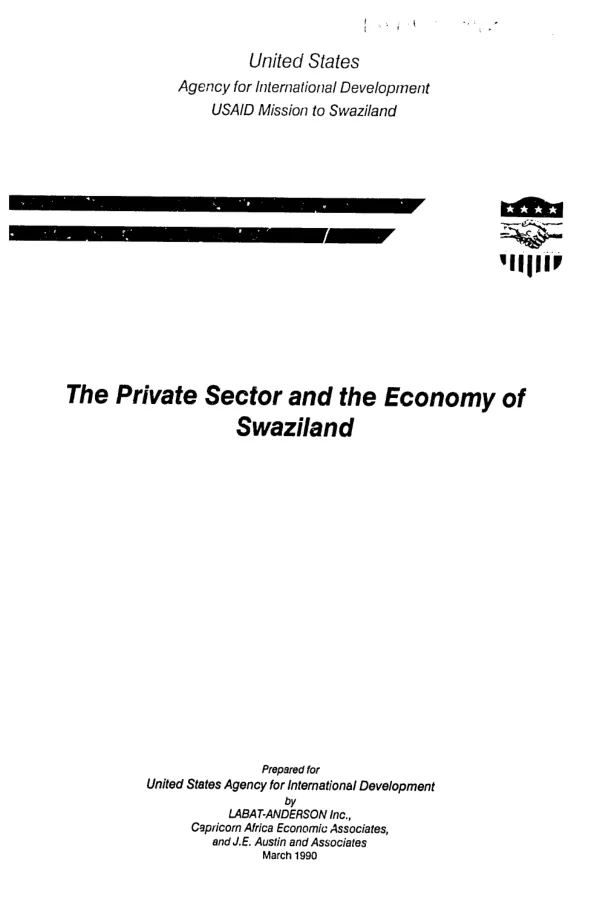
Abstract
This study discusses the past and prospective roles of the private sector in Swaziland"s economy. The study is in two parts. Part I presents an overview of Swaziland"s economy and of public and private sector activities and performance since independence. Part II sketches promising areas for private sector development and key constraints thereto. Areas of potential growth are identified as: agribusiness and agro- industry, especially forestry, fruit canning and processing, cotton and textiles, and dairy production; metal products; housing and building construction; transportation, particularly land transport; and tourism. Bottlenecks include conflicts over land tenure and land use, lack of access to credit for small enterprises, unfavorable tax policies, an inefficient bureaucracy, inadequate public services, and shortages of skilled personnel. The report also identifies the characteristics that make Swaziland"s business climate favorable for investors. These include: (1) access to varied and well-developed sources of investment capital; (2) a minimum of government interference; (3) economic, political, and social stability; (4) a well-developed network of services and markets; and (5) an inexpensive labor supply.
Connected topics
![Manual for action in the private sector (MAPS) : summary of strategy assessment [Swaziland]](https://covers.devme.ai/gen/72094.webp)