USAID. MISSION TO COSTA RICA
Private sector productivity
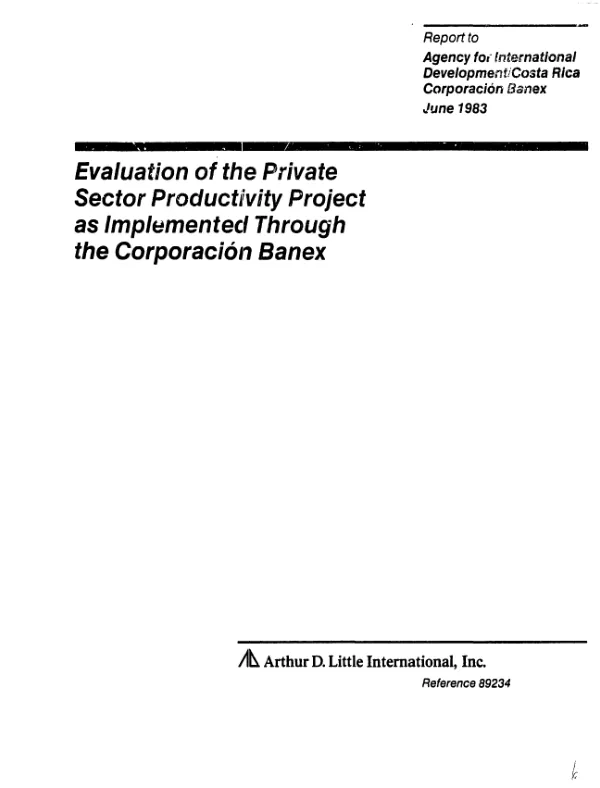
Evaluates project to promote traditional and nontraditional exports in Costa Rica by providing credit and banking services through the Banco Agro Industrial y de Exportaciones (BANEX) and establishing a subsidiary trading company (TRACO).
Torres, Carlos J.; Williams, Aaron S. · 1983
Sign in to readA free account is required to download.
Abstract
PES covers the period 9/81-8/83 and summarizes an attached external evaluation (XD-KAA-365-A) based on document review and interviews with project personnel and beneficiaries. Overall, the credit and banking services component has performed well. BANEX has developed into a professional and efficient bank. Its most important contribution has been to provide an effective alternative to a national banking system crippled by a currency devaluation. On the other hand, BANEX"s impact on the development of nontraditional exports has been limited. Dollar lending has most involved short-term credits for exports which would have received funding from other sources, while local currency lending ($1.6 million greater than planned) has been used mostly for the recapitalization of companies affected by the devaluation. Dollar lending is far below target; demand is minimal, due to the effects of the devaluation. BANEX"s aggressiveness in promoting local currency lending suggests that it is capable and flexible enough to adjust to market needs. Further, its emphasis on short-term, low-risk (i.e., not development-oriented) loans surprising, given that BANEX was initially established as a commercial bank. In contrast, due a poor implementation strategy devised by the contractor, World Trade Institute, TRACO has not developed into an effective institution. Specifically: (1) It focused on exporting surplus Costa Rican commodities to the U.S. However, the local firms that were to export the goods had originated as import substitution industries and were unable to compete in the world market in terms of product quantity, quality, and price. (2) It targeted its services at U.S. markets and buyers, rather than helping producers to develop export products. All the same, trial orders were placed by only 9 firms (instead of the planned 20) and with no material importation activity undertaken. (3) There has been little effort to develop the trading company as a self-sufficient institution. Personnel problems (turnover and a bank-initiated hiring freeze) have left a limited and underqualified staff to manage the company. (4) There is a sentiment among many Costa Rican firms that exports are a temporary market which will be abandoned once the local markets are functioning to capacity. Recommendations address the need to provide, in an integrated fashion, both venture-oriented investment lending and direct promotion of export production.
Related documents
Documents in this collection
 1993
1993USAID DEC
Project assistance completion report : training for private sector development -- cooperative agreement no. 515-0212.00 and 515-0212.01 with the Costa Rican Coalition for Development Initiatives (CINDE), September 28, 1984 to September 30, 1994
Open record 1989
1989USAID DEC