USAID DEC
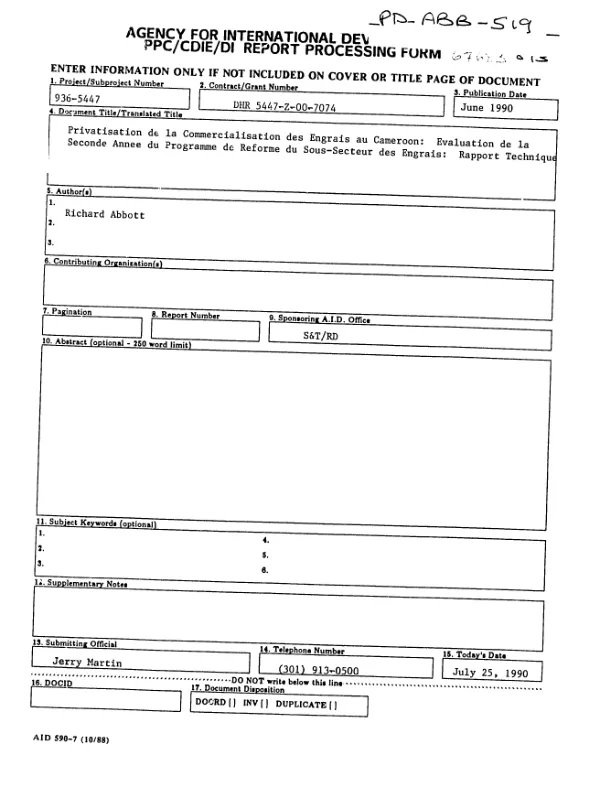
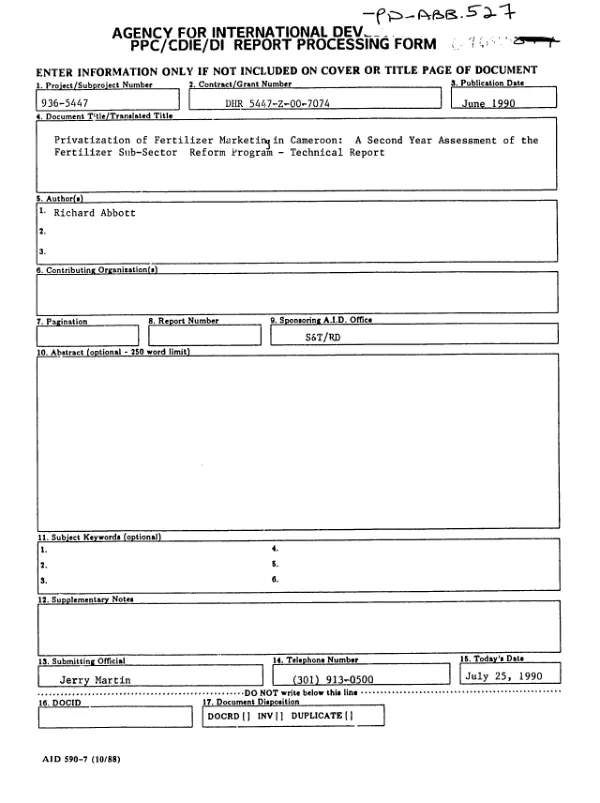
Privatization of fertilizer marketing in Cameroon : a second year assessment of the fertilizer sub-sector reform program : technical report
Sign inABT ASSOCIATES, INC.
Privatization of fertilizer marketing in Cameroon : a second year assessment of the fertilizer sub-sector reform program : technical report
Evaluates the second year (1989) of the Fertilizer Sub-Sector Reform Program in Cameroon.
Abbott, Richard D. · 1990
Sign in to readA free account is required to download.
Abstract
Some 64,170 tons of fertilizer were imported in 1989, compared to 63,000 tons in 1988; 83% of total imports had arrived by 11/89, and the final shipments were unloaded as the 1989 program closed in 2/90. The average cost for all types of fertilizer imported was slightly higher than last year. Participation in the program by commercial banks, importers, and distributors was somewhat greater than in 1988. Two importers participated (one new to the program), each accounting for approximately half of the imports. A total of 9 distributors took part; 5 were co-ops and 4 were private firms. For the first time, the Center Province was represented, along with the Littoral, West, and North West Provinces. Two commercial banks were also involved, one of them financing 83% of the shipments. Purchase of fertilizers by distributors (mainly coffee co-ops) was carried out by means of tenders submitted by importers, and selection was primarily based on price. The entire process from tender to delivery of fertilizer at Douala took 3-4 months, though later in the year there were delays caused by problems in arranging financing. Due to competition between importers, cost increases to distributors were less than would have been indicated by reduced subsidy levels. Although subsidy payments decreased 26% compared to 1988, distributors paid only 14% more, indicating that importers" margins were reduced. Distributors also reduced their marketing margins. Retail prices increased only 4%. These figures, however, mask very large differences in costs to individual distributors. For example, one large cooperative paid only half as much per ton for urea as a small cooperative in the same area. The large cooperative was also able to bargain for lower transport costs. Resulting variations in retail prices caused serious marketing problems for the small cooperative. While anomalies of this type are inevitable in the transition to a private enterprise system, there are indications that some of the smaller distributors lacked understanding of commercial and banking practices. The performance of the program in 1989-90 was and is being strongly affected by the economic crisis in Cameroon. The lack of liquidity in both the public and commercial banking sectors has greatly impeded financing of fertilizer import and distribution. Effective demand for fertilizer has been reduced by the failure of the Office Nationale de Commercialisation des Produits Bruts (ONCPB) to pay co-ops and farmers for coffee already delivered. Under the structural adjustment program in Cameroon, settlement of ONCPB arrears in coffee payments has been scheduled and this is vital if fertilizer sales are to be maintained anywhere near present levels. Generally, the program"s importation and distribution loan facility could do little to ameliorate the extremely tight credit squeeze. Liberalization of coffee marketing has started in Cameroon and should, in time, reduce the role of the ONCPB, making co-ops more independent of government structures and permitting them to export coffee and cocoa directly. Financing of fertilizer imports will then become much easier for these co-ops since they will be able to use the coffee as collateral for loans. Declining world market prices for coffee and cocoa, from which Cameroonian farmers have been sheltered through ONCPB price policies, are beginning to affect the program with the announcement of drastic reductions in producer prices for 1990. In fact, coffee prices for 1990 are less than half the 1989 levels. While it is too early to predict the effect on fertilizer sales, it seems clear that some reduction in demand will occur. Such information as is available on cost/benefit ratios for fertilizer use on coffee indicate that terms of trade for farmers at present are such that fertilizer use may no longer be beneficial for marginal producers. In the shorter term, the program experienced problems due to over optimistic sales expectations by distributors and importers, based largely on 1988"s performance. This has led to the importation of more fertilizer than could be sold during the 1989-90 crop year under present tight credit conditions. The result was a scaling back of the lifting of fertilizer from the port by distributors, excessive accumulations of fertilizer stocks at the port, and severe financial strains on importers. Importers are likely to be left with substantial unsold stocks until coffee co-ops are again in the market for fertilizer (in 9/90, or possibly not until 3/91). The concept of the program is basically sound and seems to be acceptable to most participants. Increased participation by distributors, continued interest by a number of importing firms, and proportionally lower fertilizer prices are three encouraging signs that the program is beginning to achieve its objectives. (Author abstract)
Related documents
Documents in this collection
 1990
1990USAID DEC
Privatization of fertilizer marketing in Cameroon : a second year assessment of the fertilizer sub-sector reform program : technical report
Open record 1992
1992USAID DEC