THE FUTURES GROUP INTERNATIONAL, INC. (TFGI)
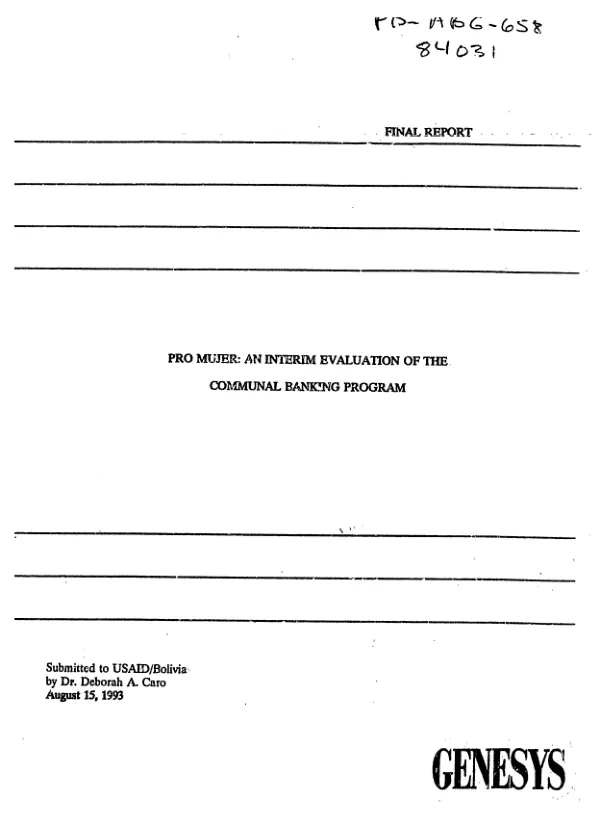
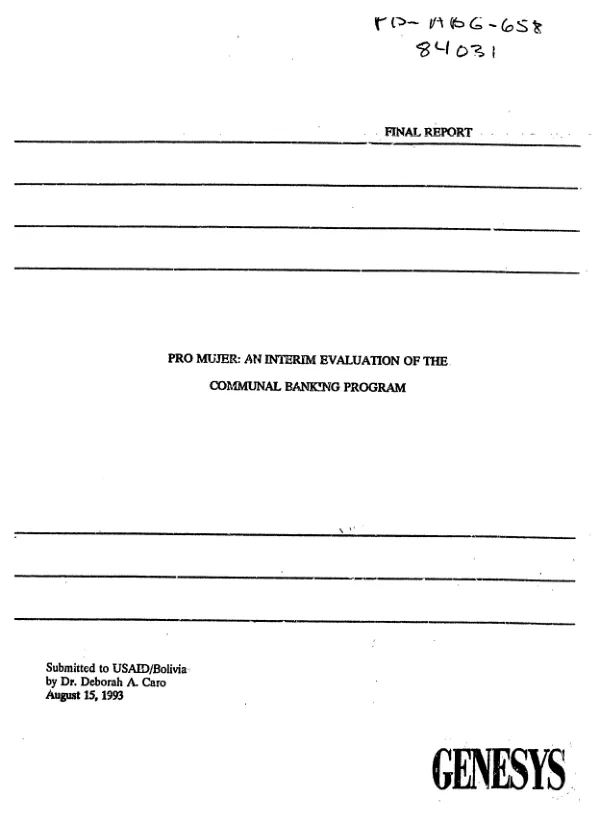
PRO MUJER : an interim evaluation of the communal banking program
Evaluates the business skills and communal banking program of PRO MUJER, a women"s training and support organization in Bolivia.
Caro, Deborah A. · 1993
Sign in to readA free account is required to download.
Abstract
The program, financed under the Mission"s P.L. 480 Title II program, supports research, training, and TA to enhance the integration of women into multi-sectoral development programs in Bolivia. Interim evaluation covers the period 1992-4/93. The PRO MUJER program serves one of the most disadvantaged segments of El Alto"s urban population. About 40% of the participants are illiterate and less than a third have more than an elementary education; their net incomes average $20 for a 50-hour work week. More than 95% speak Aymara or Quechua as a primary language and over 74% are migrants from rural areas. Few qualify for formal credit or even meet the minimum criteria for loans from targeted microenterprise programs such as PRODEM or Banco Sol. PRO MUJER appears to be effectively stimulating income generation among this target group through training, credit, and empowerment activities. The business and banking skills courses offer a unique approach to credit programs for microentrepreneurs. The methodology of providing 19 lessons, 14 on business skills and 5 on communal bank management, prior to providing credit, strengthens participants" abilities to assess the viability of their business, builds their ownership over the bank and its assets, and develops management skills prior to providing economic resources. The real impact of the training can be seen in the women"s capacity to manage the banks. Group and individual interviews with women in the communal banks, and other informal interviews indicate that women now use business plans and other skills developed through the training to improve their businesses. While it is too early to measure the impact of the communal banks program on the participants" businesses and income, there is anecdotal evidence that most women have been able to increase their earnings. There is also anecdotal evidence of the participants" interest in and commitment to the banks. PRO MUJER has set income as the primary indicator of success. The evaluation recommends rethinking this indicator and substituting proxies for income, as well as adding process indicators, such as the number of participants that meet the eligibility criteria for borrowing from other microenterprise programs. In the process, the project can contribute to knowledge about microenterprise growth without being held to an unrealistic standard. After considerable debate and analysis, PRO MUJER management have concluded that their primary mandate is to provide high-quality training, and that the communal banks are principally a vehicle for training women from disadvantaged areas of El Alto to manage credit and become familiar with the workings of financial institutions. An expected result of the banking program in the future will be to prepare PRO MUJER"s program participants to deal with other micro-credit institutions and formal banking structures. PRO MUJER"s strength is in its training. It needs to retain this focus and not be pulled into service delivery or long-term financial intermediation. At the same time, PRO MUJER has the capacity to expand beyond direct implementation into providing TA to other agencies. A mixed approach of direct program implementation, as a laboratory for program and materials development, in conjunction with increased training of other agencies, will achieve two objectives: (1) effective education and economic development of disadvantaged populations; and (2) increased NGO capacity. (Author abstract, modified)