JOHN MELLOR ASSOCIATES, INC.
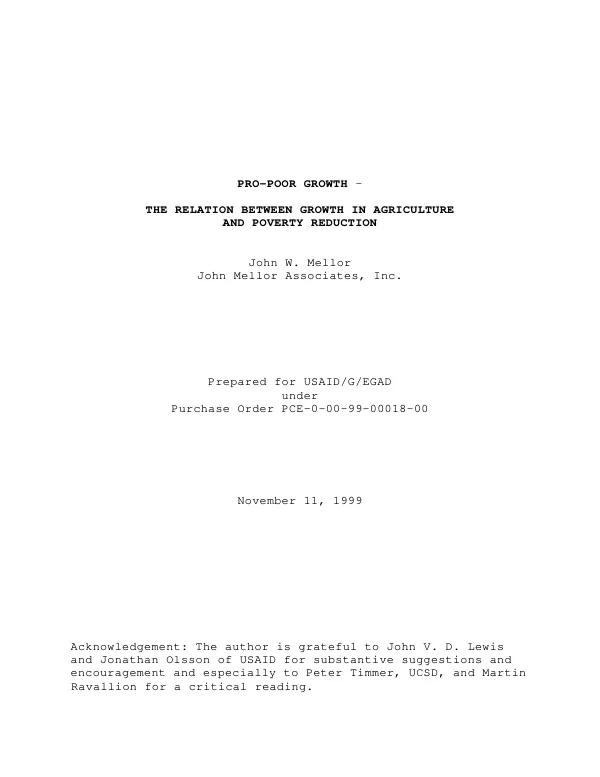
Pro-poor growth : the relation between growth in agriculture and poverty reduction
In the past few decades, Asian countries have seen an extraordinary (though now slowing) reduction in poverty and the disappearance of famine.
Mellor, John W. · 1999
Sign in to readA free account is required to download.
Abstract
In Africa, by contrast, poverty is steadily growing, famine is so ubiquitous that complex, permanent famine early warning systems have been developed, in apparent disbelief that Africa can ever prosper. This paper accounts for these contrasting relations by showing the importance of: (1) agricultural growth, particularly through its effect on employment in the small-scale rural non-agricultural sector, on poverty reduction; and (2) public expenditure on agricultural growth and hence on poverty reduction. A final section draws conclusions with respect to development expenditures, particularly for foreign aid. According to the report, the importance of agricultural growth and of related public expenditures explain much about poverty reduction. Specifically, they explain: (1) why growth does not always bring down poverty levels -- unless it is agricultural growth, it is the wrong structure; (2) why the right structure takes time -- the effects are indirect and must work their way through the system; (3) why so much of the world (all of Asia, for example) is finding its way out of poverty -- because agriculture developed in those areas; (4) why poverty reduction is slowing in those same areas -- because agricultural growth has received much less attention in the last decade and so has slowed, a slowing reinforced by foreign aid pressures for indiscriminate budget cuts; (5) why Africa has been such a disaster from a poverty reduction point of view -- because national governments are urban-oriented and -biased and because, in contrast to the record in Asia, foreign aid stopped pressuring for emphasis on agriculture over the past two decades; and (6) why foreign aid is so important to agricultural development -- because government actions are critical to agriculture and low- income country governments tend to be strongly urban biased. Includes references.