NATIONAL RESEARCH COUNCIL. COMMITTEE ON JOJOBA UTILIZATION
Products from jojoba : a promising new crop for arid lands
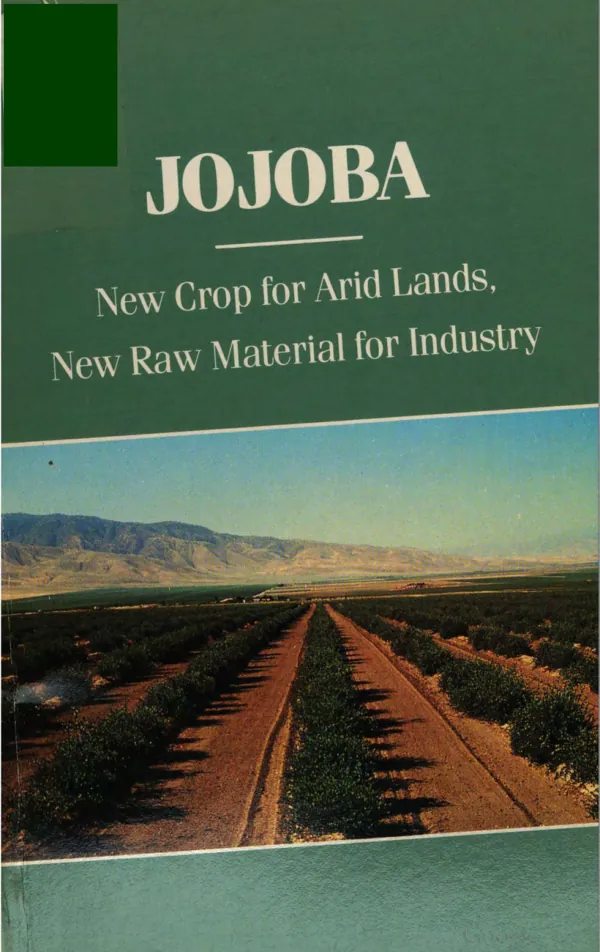
The desert plant jojoba (Simmondsia chinensis (Link) Schneider) grows wild over an extensive arid area in the Sonoran Desert that covers parts of Arizona, California, and Mexico.
1970
Sign in to readA free account is required to download.
Abstract
Estimates of the amount of seeds produced each year in jojoba"s native habitat are over 100 million pounds. The cultivation of jojoba, the manufacture of products from it, and the utilization of its by-products would greatly improve the economic situation of some native peoples and reservations in the area. Jojoba seeds contain about 50 percent by weight of a colorless, odorless oily liquid with unusual properties that is commonly referred to as "jojoba oil." The oil is chemially a liquid wax made up of nongliceride esters having a narrow range of chemical composition; the esters are almost entirely composed of straight-chain acids and alcohols, each with 20 or 22 carbon atoms and 1 unsaturated bond. Jojoba oil is unique: an unsaturated, liquid wax that is readily extractable in large quantities from a plant source. Waxes of this type are difficult to synthesize commercially; the only other natural source is the sperm whale, an endangered species. Waxes are used in many industries for a wide variety of applications in lubricants, paper coatings, polishes, electrical insulation, carbon paper, textiles, leather, precision casting, and pharmaceuticals. Jojoba oil is potentially useful for all these products. Liquid jojoba oil can be hydrogenated to a hard, colorless solid resembling spermaceti (a solid saturated form of sperm oil also obtained from sperm whales), carnauba wax, and beeswax in both chemical structure and properties.