USAID. MISSION TO PHILIPPINES
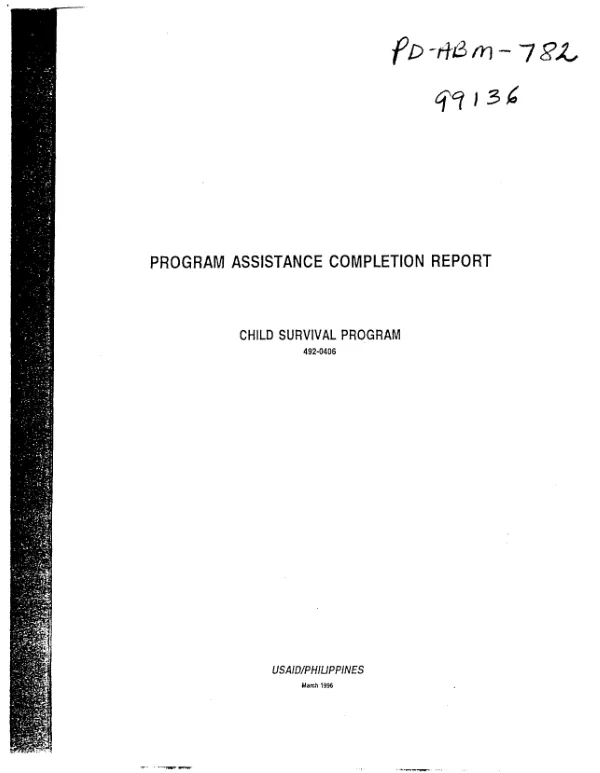
Program assistance completion report : child survival program
PACR of a child survival program (10/89-3/95) in the Philippines.
1996
Sign in to readA free account is required to download.
Abstract
The PACR has two parts, covering (1) the original program period (10/89-12/93) -- see PD-ABM-027 for an evaluation abstract covering this period; and (2) supplemental assistance (1/94-3/95) provided to the Philippine Department of Health (DOH) to strengthen the capabilities of local government units (LGUs) in the area of child survival -- covered in this abstract. During the supplemental assistance period, the program provided TA to the DOH in several technical areas. When Depo-Provera (DMPA) was approved for use in the Philippines in 11/93, the DOH, with program TA, developed and implemented a plan to introduce DMPA throughout the country. DMPA was included in the contraceptive social marketing project, and 5,027 doctors, nurses, and midwives were trained in its use by 3/95. Mechanisms are now in place to ensure the availability of DMPA and of trained LGU-level personnel to administer it. The program also provided TA to help the DOH in its campaign against vitamin A, iodine, and iron deficiencies. At its annual National Micronutrient Day in mid-October, the DOH distributes Vitamin A capsules to children aged 1-5, iodine capsules or iodized oil to mothers, and vegetable seed packets and malunggay cuttings to families. A surveillance system monitors adverse reactions to the high dose Vitamin A capsules, and informational booklets are disseminated to workers and community volunteers. The program, which reaches 90% of the targeted children with Vitamin A capsules, has been authorized for another 3 years. In addition, the program assisted the 20 LGUS selected to participate in the DOH's LGU Performance Program (LPP) in developing their family planning/maternal child health plans. In 1995, the 20 LGUS received a grant from the DOH to implement these plans. The program also helped develop sustainable information strategies for the LPP, using a buy-in to the Data For Decision Making Project to provide TA to the DOH in establishing a rapid appraisal system for two regions (Cordillera Autonomous Region and Bicol Region). This involved establishing a set of consensus health indicators, setting up computer workstations for data analysis and interpretation, developing communication tools to enhance dissemination of information to key decision makers, and providing management training to LGU officials and staff. Finally, a program advisor helped the DOH design a Women's Health and Safe Motherhood Project, which will be funded by five other donors. USAID's follow-on program -- Integrated Family Planning/Maternal Health (4920480) -- will adopt the performance-based disbursement mechanism and most of the implementation mechanisms employed under this program.