AURORA ASSOCIATES, INC.
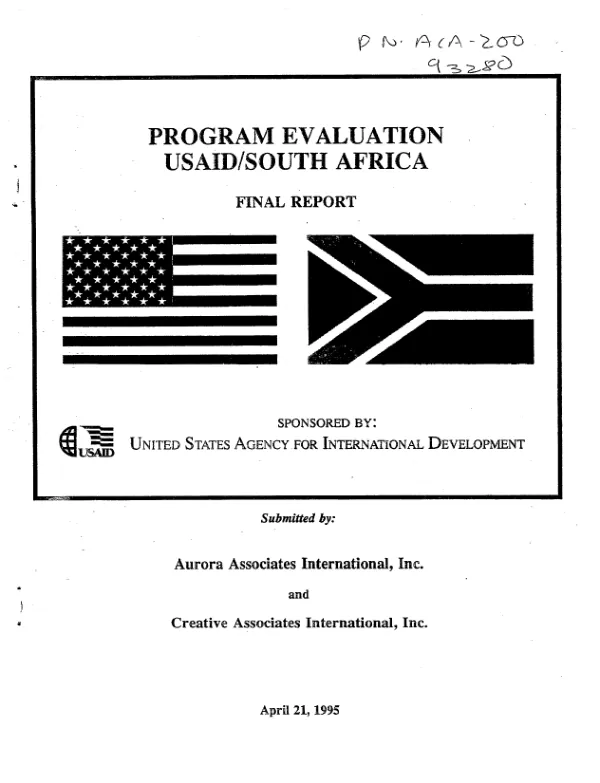
Program evaluation USAID/South Africa : final report
From 1986 until 1993, USAID/South Africa implemented a program of social, political, and economic development projects aimed at ending apartheid and empowering its victims.
Brown, Robert S.|Statman, James M. · 1995
Sign in to readA free account is required to download.
Abstract
This report describes those efforts and assesses their effectiveness, with an eye toward lessons learned that might be used by other USAID Missions working in similar circumstances; a discussion of the history of U.S. policy towards South African apartheid is included. Key lessons learned are as follows. (1) Program experience has helped identify some political, economic, and social characteristics that are congenial to a political- or empowerment-driven aid program and some that are more congenial to an economic development-driven aid program. If placed in a matrix, these results can be used in future development programming. (2) The types of activities -- political empowerment or economic development -- that a Mission implements tend to determine its operational style and evaluative method. The former require flexibility and finesse and are often short-term and should evaluate process, while the latter are more technical and can be more readily evaluated through an examination of technical outputs. (3) The labor-intensive, foundation-type community outreach projects used in South Africa require more employees per project dollar than do more traditional projects. Further, turnover of the U.S. staff helped the Mission maintain its flexibility, while the longevity of the foreign service national employees provided continuity and institutional memory. Human relations skills were more valuable in political empowerment activities while technical proficiency was more useful in development activities. (4) The large and sophisticated network of NGOs and community-based organizations (CBOs) in South Africa was vital to the Mission's effort. Missions working in areas without such a mature NGO/CBO network might want to consider creating one before providing other types of assistance. (5) Perhaps the principal lesson is that USAID can work effectively over a sustained period, within a dynamic context of extreme political, social, and economic struggle and change if given adequate autonomy, protection, and flexibility. Although administratively burdensome, direct assistance to pluralistic constituencies strengthens civil society and enhances USAID's standing and influence within a country. However, given the size of the Mission staff, the model of direct funding of numerous obligations to South African grantees has placed too great a workload on staff; the model has begun to break down. Either the number of personnel or intermediary agents needs to be increased or the number of grantees needs to be decreased. Includes case studies and a bibliography.