USAID DEC
Programa de Participación y Reparación Colectiva de las Víctimas (PPRCV)
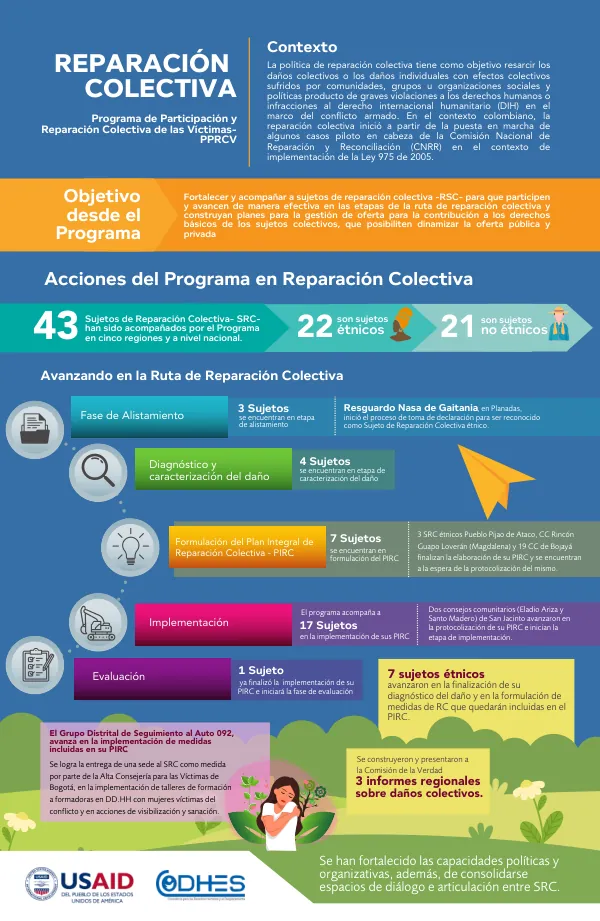
The policy of collective reparations aims to compensate for collective or individual damages with collective effects suffered by communities, groups, or social and political organizations as a result of severe human rights violations or breaches of international humanitarian law in the context of armed conflict.
1 pages
Sign in to readA free account is required to download.
Abstract
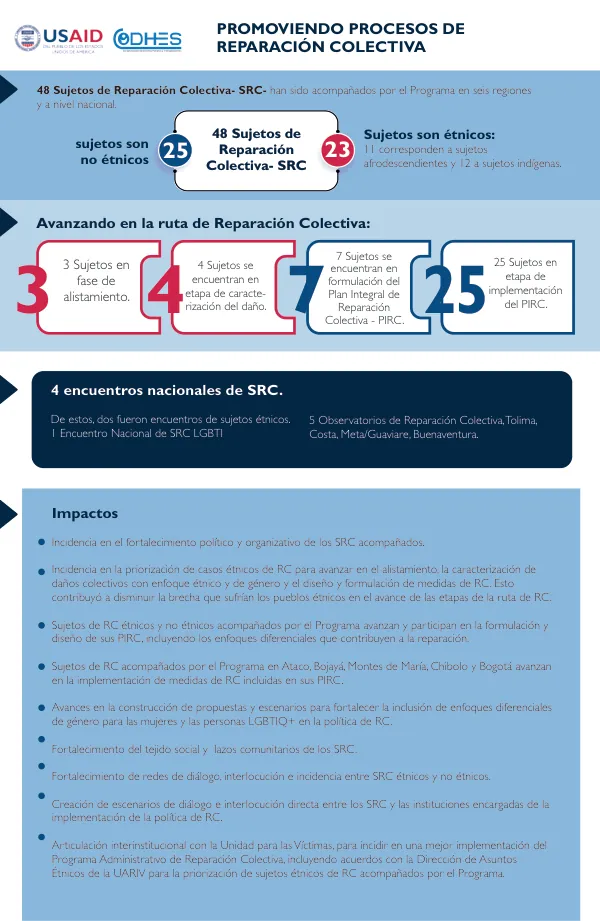
In the Colombian context, collective reparations began with the launch of pilot cases led by the National Commission for Reparation and Reconciliation (CNRR) in the context of implementing Law 975 of 2005. The Program for Participation and Collective Reparation of Victims (PPRCV) seeks to strengthen and accompany subjects of collective reparations (RSC) to participate effectively in the stages of the collective reparations route and build plans for the management of offer for the contribution to the basic rights of collective subjects, enabling the dynamization of public and private offer. The program has accompanied RSC in five regions and at the national level. RSC have been accompanied by the program in various stages of the collective reparations route. In the implementation phase, 17 subjects are being accompanied in the implementation of their Integral Plan for Collective Reparation (PIRC). Seven subjects are in the process of formulating their PIRC, while four subjects are in the stage of characterizing the damage, and three subjects are in the stage of alistamiento. One subject has already completed the implementation of its PIRC and will begin the evaluation phase. The program has also supported the implementation of measures included in the PIRC of the District Group for Monitoring Auto 092. Additionally, a headquarters was delivered to the RSC as part of the measures taken by the High Counselor for Victims in Bogotá, and training workshops were held for trainers in human rights with women victims of the conflict, as well as actions of visibility and healing. Furthermore, three regional reports on collective damages have been produced, including the Resguardo Nasa of Gaitania, which initiated the process of taking declarations to be recognized as an ethnic subject of collective reparations.