USAID
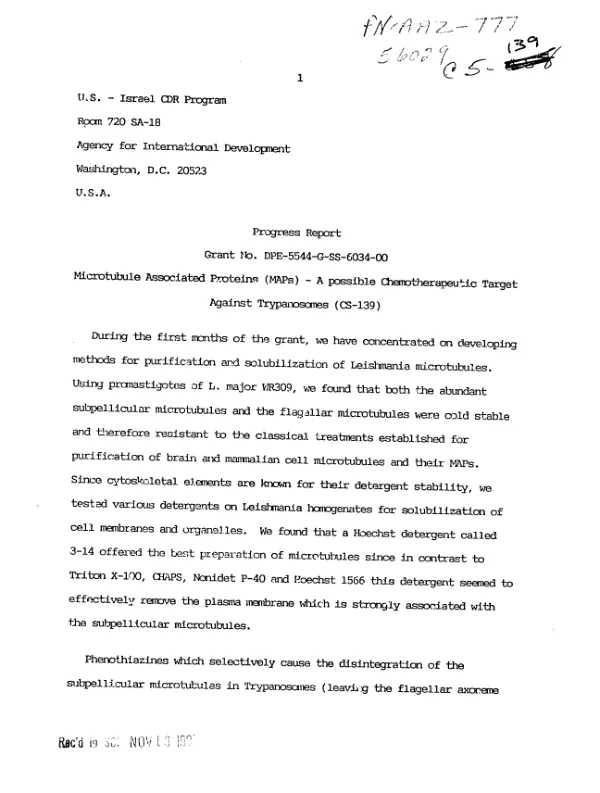
Progress Report
The Microtubule Associated Proteins (MAPs) project, funded by the Agency for International Development, aims to investigate the potential of MAPs as a chemotherapeutic target against Trypanosomes.
4 pages
Sign in to readA free account is required to download.
Abstract
The project focuses on Leishmania microtubules, which are cold stable and resistant to classical purification methods. Researchers have developed a method for purification and solubilization of Leishmania microtubules using a Hoechst detergent called 3-14, which effectively removes the plasma membrane associated with the subpellicular microtubules. Initial experiments showed that phenothiazines, which selectively cause the disintegration of subpellicular microtubules in Trypanosomes, had no effect on L. major promastigotes. The insoluble preparation of microtubules obtained by the 3-14 detergent consisted of tubulin and several unidentified proteins that could qualify as MAPs. The microtubules were cold stable, insensitive to colchicine and calcium ions, but could be depolymerized to a certain extent by high ionic strength. Further studies involved the isolation of proteins associated with the microtubules, which were achieved by fractionation of the salt-solubilized and dialyzed proteins on a cation-exchange column. The proteins were found to have molecular weights of 70, 60, 35, and 20 kDa. To study the role of these proteins in microtubule polymerization and association, it was necessary to isolate the individual proteins. This was achieved by fractionation of the salt-solubilized and dialyzed proteins on a cation-exchange column. Polymerization studies were conducted using calf brain tubulin and Leishmania proteins. The addition of Leishmania proteins to calf brain tubulin resulted in the formation of bundles of microtubules, which is reminiscent of the subpellicular network seen in the parasite. This suggests a role for the purified proteins in the specific organization of the subpellicular microtubules in these organisms. The researchers also carried out parallel experiments on Trypanosomes, which showed similar results, but with some differences in the behavior of the microtubules. The project has also involved the development of polyclonal antibodies against Trypanosome MAPs, which will be used for further studies. The researchers plan to summarize their work shortly and send preprints when available.