USAID DEC
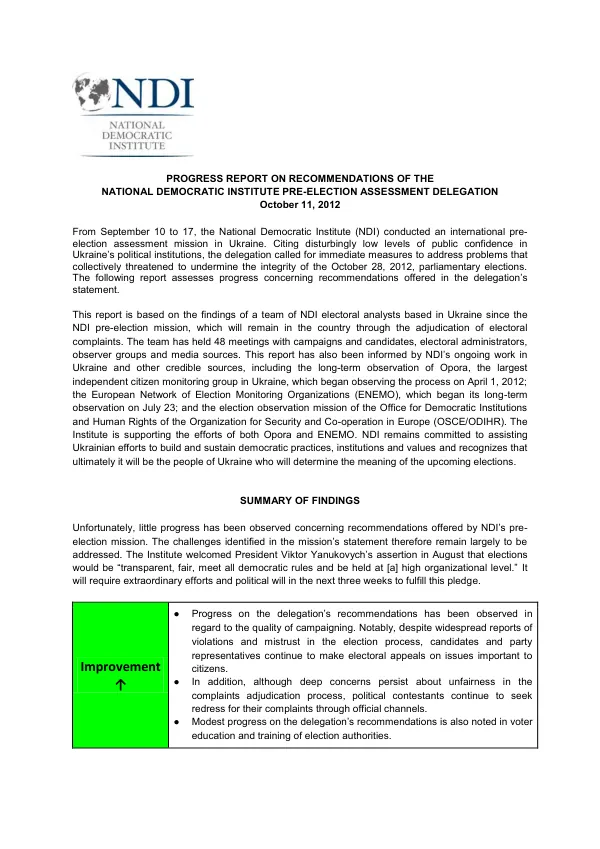
Progress Report on Recommendations of the National Democratic Institute Pre-Election Assessment Delegation
Sign inTHE NATIONAL DEMOCRATIC INSTITUTE
Progress Report on Recommendations of the National Democratic Institute Pre-Election Assessment Delegation
The National Democratic Institute (NDI) pre-election assessment delegation in Ukraine identified several challenges that threatened the integrity of the October 28, 2012, parliamentary elections.
2012 · 9 pages
Sign in to readA free account is required to download.
Abstract
The delegation called for immediate measures to address these problems, citing disturbingly low levels of public confidence in Ukraine's political institutions. The NDI delegation observed that the quality of campaigning had improved, with candidates and party representatives making electoral appeals on issues important to citizens. Additionally, although deep concerns persisted about unfairness in the complaints adjudication process, political contestants continued to seek redress for their complaints through official channels. Modest progress was also noted in voter education and training of election authorities. However, mixed results were observed in the area of voter registration. The Central Election Commission's (CEC) resolution limiting last-minute changes of electoral addresses to other polling stations within the same single mandate district prevented attempts to transfer votes to more electorally strategic districts. Nevertheless, no provision was made for voters with legitimate needs to be away from their districts on election day, and these voters may be disenfranchised. A large number of observers were engaged in monitoring the elections, but it was incumbent upon groups to be transparent about their methodologies and funding, and to adhere to global principles for election observation. The continued lack of media diversity was of particular concern, as was the insufficient safeguard on the use of web cameras in polling places. Observers also reported that allegations of bribery and abuse of administrative resources were not being fully investigated. In recent weeks, ENEMO and party representatives reported an increase in incidents of harassment, threats, intimidation, and, in some cases, violence against candidates and their campaign staff. The process through which precinct election commission (PEC) members were selected resulted in a lack of political balance on commissions, replicating a problem identified by the delegation in the formation of district election commissions (DECs). Recently passed legislation on web cameras was developed without meaningful public consultation, and the unilateral decision to halt live broadcasting of web cameras during counting and tabulation undermined the transparency of these critical aspects of election day. The proposed and actual changes to election-related legislation continued to raise concerns, including a recent proposal to recriminalize libel and to impose criminal penalties for any 'positive statements' about homosexuality. Although it was subsequently withdrawn, the libel law was particularly ill-timed. Legislation defining the parameters of citizens' freedom of assembly remained in parliament and could be moved forward at any time, despite serious objections raised by civic groups. The ongoing legislative debates on fundamental freedoms, as well as a number of changes to election-related laws and regulations, had placed a burden on election authorities, who possessed limited resources, and had made it difficult for citizens to understand their rights and responsibilities. Candidates and parties were also forced to reevaluate their strategies as the legal parameters around the campaign environment shifted. Training of election commissioners had begun, but at the DEC level, only chairs, deputy chairs, and secretaries were being trained. This placed the onus for training the remaining DEC members on parties, many of which lacked the capacity to provide it. Trainings for PEC members were currently taking place, but large numbers of PECs continued to replace members, as very small parties that won seats in the lotteries were unable or unwilling to field commissioners. The CEC and a few civic groups had recently initiated civic and voter education efforts, which consisted of public service announcements, internet advertising, posters, and literature distribution. Questions remained about their reach and comprehensiveness, due to the extent of changes in the election process, particularly the re-introduction of single mandate districts. Election administrators at all levels should receive comprehensive, consistent guidelines and training so they may fulfill their responsibilities competently and fairly. The CEC, political parties, and non-governmental organizations (NGOs) should conduct extensive civic and voter education efforts so that citizens understand their rights and responsibilities under the new law. Election authorities should administer the elections fairly, consistently, and in accordance with the law and international standards. Media outlets and individual journalists in Ukraine continued to face harassment, and the range of information and opinion available to Ukrainian voters remained limited due to the concentration of media ownership in the broadcast field. The situation surrounding TVi, the only national channel that reliably covered the political opposition, was particularly troubling, as it continued to be excluded from the cable companies' affordable packages, limiting pluralism in the media environment.