BHM INTERNATIONAL, INC.
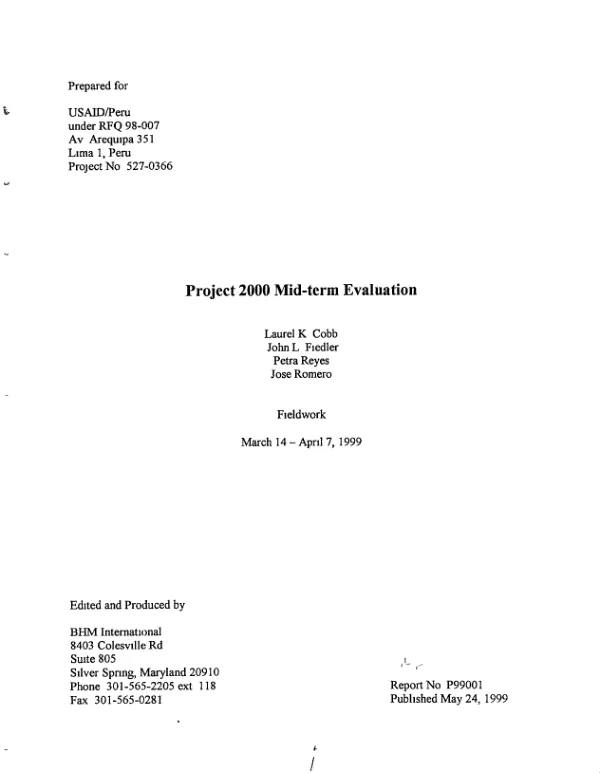
Project 2000 mid-term evaluation
Evaluates Project 2000, designed to increase the use of maternal and child health (MCH) interventions in 12 areas in Peru.
Cobb, Laurel K.|Fiedler, John L. · 1999
Sign in to readA free account is required to download.
Abstract
Interim evaluation covers the period 9/93-4/99. Pathfinder International is the implementing agency. While Project 2000's overall thrust remains unchanged, a shift in emphasis from service utilization and service outputs to functional outputs and process activities requires that the project's objectives and scope be modified, and that service utilization and service outputs link functional and process activities with anticipated changes in utilization of health services, health status, and sustainability. The notable success of Project 2000 is PCMI, the training/service quality program in reproductive, maternal, perinatal, and child health. In PCMI, Project 2000 is piloting a model combining innovative approaches to human resources development and quality improvement for MCH services in 89 health establishments in the 12 targeted regions. Phase I is proceeding successfully at the basic qualification level, and is showing evidence of improving quality of MCH services and increasing their utilization, although the training schedule is about 2 years behind schedule, since the shift in core activities delayed the roll-out of the PCMI until a little more than 1.5 years ago. The PCMI is now at a critical juncture for deciding whether to focus on vertical increases in levels of quality or a horizontal spread of minimal quality improvements to the 2,500 establishments in those regions. To support PCMI, Project 2000 has improved drug management, evaluated the national health information system, and developed supervisory approaches for the PCMI program in the 89 hospitals. An information, education and communication (IEC) component to the project started late and needs strengthening. In the project's financial management and health financing components, the Budget Programming System (SPP) is the most significant output; it is a powerful and flexible electronic spreadsheet-based software program for estimating both unit and total costs of Ministry of Health (MOH) facility activities and represents an important break with the top-down methods of the past. The second significant output is the Cost and Income Information System (SICI), a step-down cost analysis software tool implemented in three hospitals. The SICI system is designed to be compatible with the SPP. However, while there are several indicators of the potential sustainability of the SPP and SICI, more networking with Ministry of Economy and Finance (MEF) personnel is needed to ensure that the systems are adapted to MEF's needs and requirements. The prospects for PCMI's sustainability appear strong. On the level of individual service institutions, the potential for sustainability is excellent. Regional authorities, hospital directors, and service providers "own" the improvements. Also, patients and their families are recognizing and appreciating the positive changes in PCMI-assisted hospitals; much more work is needed, however, before communities are knowledgeable about healthy behaviors, danger signs, and when to seek help, and routinely demand high-quality MCH services. Finally, the fact that the Government of Peru and the MOH more than made up for a shortfall in P.L. 480 funding for the PCMI, together with the MOH's universally enthusiastic support for the PCMI augur well for the financial sustainability of project interventions. Two factors have led to delays and conflict. The first is the complex structure of the project. Pathfinder's counterpart is a Special MOH Unit (UEP 2000) that reports to the MOH's Office of Financing, Investment and External Cooperation rather than to MCH line departments. Pathfinder itself has two main subcontractors that in turn have further subcontracts. Second, the UEP 2000 takes literally a statement in the Project Agreement and Pathfinder contract that the MOH will personally approve all project documents that authorize procurement of services and will participate fully with USAID in guiding and monitoring the project.
Related documents
![Activities to improve the delivery of primary healthcare [health care] services in the Department of Boaco[, Peru] : mid-term evaluation](https://covers.devme.ai/gen/5009.webp)