USAID DEC
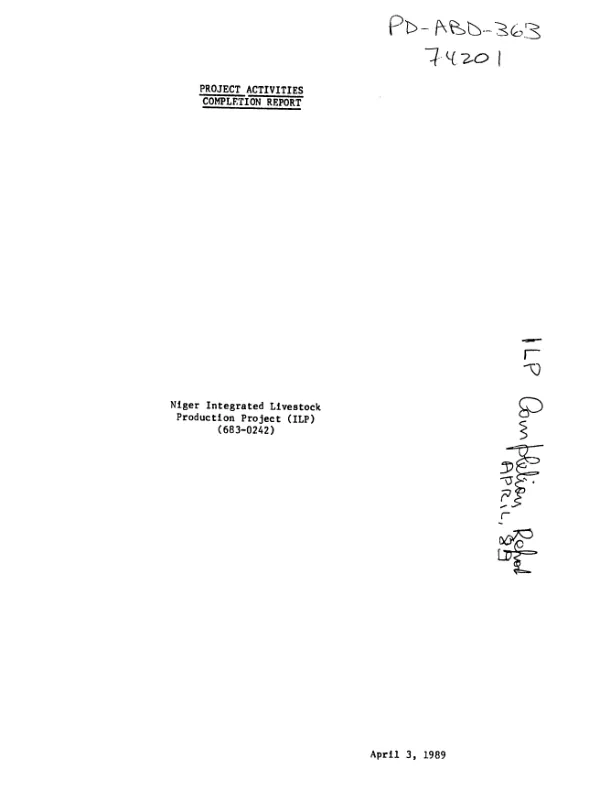
Project activities completion report : Niger integrated livestock production project (ILP) (683-0242)
Sign inUSAID. MISSION TO NIGER
Project activities completion report : Niger integrated livestock production project (ILP) (683-0242)
PACR of a project (1983-1988) to establish a herder organizational structure in Niger and to increase the capacity of the Government of Niger (GON) to provide services to herders.
1989
Sign in to readA free account is required to download.
Abstract
In response to the 1984 drought, the project was redesigned to focus on building up the policy analysis capacity of the Ministry of Animal Resources/Hydrology (MAR/H). The project also continued to develop a nationwide market information collection system, a thermostable vaccine against rinderpest, and a pastoral zone early warning system. All other activities were eliminated; this included efforts to organize new herder groups, although the project did maintain contact with the groups previously established and produced a study on their organization. The project completed the four planned studies related to livestock and grain marketing, and the marketing information system is installed in all seven department of the country. Training was provided to 110 technicians in computer use and market monitoring. The thermostable vaccine against rinderpest is being field-tested and is produced locally by the GON's veterinary laboratory. As a result of project activities, the laboratory has a strong diagnostic capacity. The project also trained a total of 55 veterinary auxiliaries and 20 livestock service field staff, although these agents have been handicapped by transportation constraints. Only one of the five proposed mobile vaccination parks was realized, due to budgetary constraints and delivery problems. The pastoral early warning system has been expanded from 3 to 6 departments. Two technicians were trained in the United States for satellite data analysis and 32 in Niger for ground truthing. Several lessons were learned. (1) Livestock projects, especially those that involve the institutionalization of new concepts, are necessarily long term in nature. (2) Project design should involve analysis of similar projects in the same region in order to determine realistic targets. (3) Definitions of project tasks and outputs should be specific. (4) Host country limitations concerning personnel and funding available should be taken into account. (5) Host country staff participating in advanced degree programs may not be assigned to the project when they return because they are in such high demand to staff higher-level positions. (6) Sound project management systems -- including sound accounting/financial management procedures and, where needed, an adequate inventory system -- are vital to project success. (7) Counterpart training and the continuity of host country personnel are essential to project sustainability. Recommendations for Phase II of USAID's Agricultural Sector Development Grant (6830257/0265) are included.