USAID DEC
Project activity completion report : commercial agricultural production and marketing
Sign inUSAID. MISSION TO SWAZILAND
Project activity completion report : commercial agricultural production and marketing
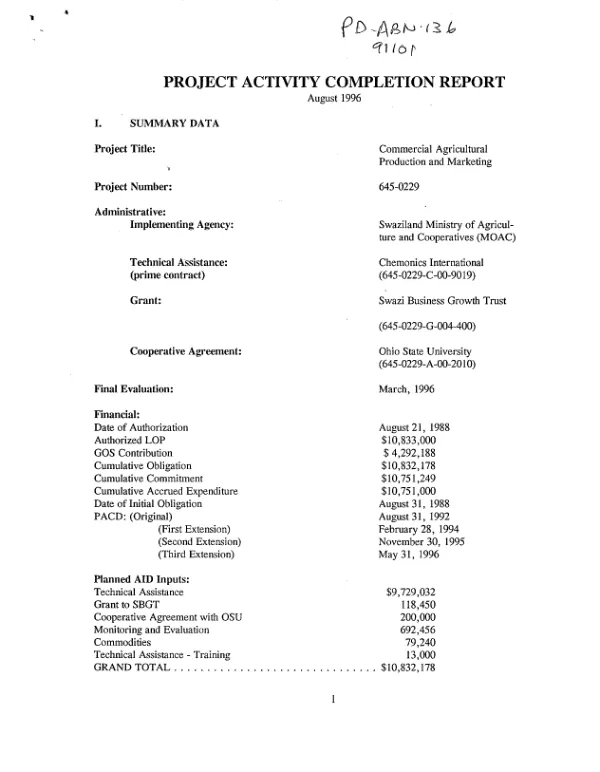
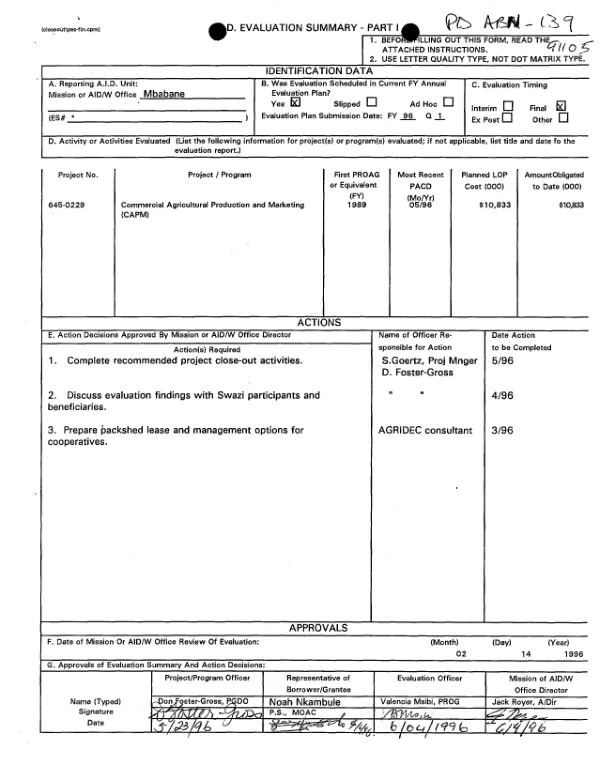
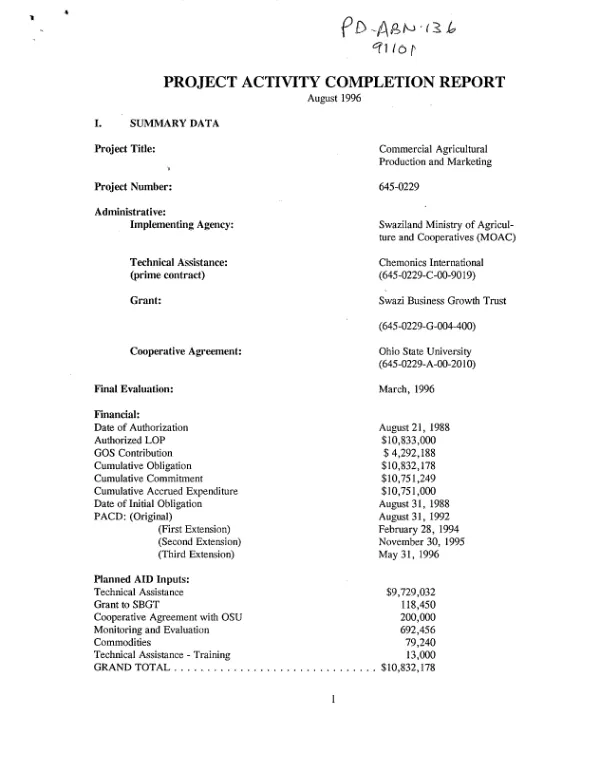
PACR of a project (8/88-3/96) to promote small-scale commercial agricultural production and marketing in Swaziland (CAPM project).
1996
Sign in to readA free account is required to download.
Abstract
The project was implemented in three differing phases. Phase I, the original design, was focused on policy change and was abandoned after less than 2 years. Phase II was designed for more direct assistance to farmers and local marketing organizations, including infrastructure development. A mid-term evaluation showed that the Phase II approach was not going to achieve the intended outcomes, resulting in the final design, Phase III, which focused on developing farmer organizations as means to plan and market production. The work with individual farmers, continued over from Phase II, was the project"s most successful aspect. Improved practices and increased income from horticultural crops seem well established. The development of farmer organizations, the express focus of Phase III, has been less successful; it is generally agreed that this output was overly ambitious for the short time available in Phase III. While CAPM advisors were able to find marketing channels for the cooperatives" produce, it does not appear that lasting relationships between regional and local markets and the farmer organizations have been established. At the EOPS level, project efforts led to the development of two agricultural cooperative societies, Khulemela Kwenta (KK) and Hhohho (HFV), both of which were serving their intended functions by the end of the project. The project has met or exceeded its goal to strengthen 150 farmers on 120 hectares so that they are capable of producing marketable horticultural crops to meet market demand. Despite variations and shifts in market conditions, the average increase in net income per hectare for participating farmers has far exceeded the target; December 1995 data shows an average income per hectare of E16,603. In 1995, the total value of CAPM exports to regional markets is expected to reach E650,000; to domestic markets, about E600,000. In terms of sustainability, 10 of the 20 large private growers who participated in Phase II continue to produce 1,500 metric tons of fruit and vegetables annually on 80 hectares, and one of the marketing companies helped during Phase II is still thriving. CAPM also provided institutional strengthening to the National Marketing Board and the Ministry of Agriculture and Cooperatives (MOAC) research and extension staff. In addition, CAPM established produce packing facilities at KK and HFV, developed policies, procedures, and operating systems for the two entities, and provided training in their use. Of the 320 small horticultural producers who benefitted from CAPM, about 70 are likely to continue commercial farming operations. During the last 4 years of CAPM, some 300 training events were carried out, a third of them concerned with production, including water management techniques, ways to "scout" fields for disease and insect damage, and the use of protective clothing and gear when dealing with hazardous materials. Two institutional arrangements entered into under the project proved successful. The Swazi Business Growth Trust (SBGT) developed an agribusiness loan program which can be fully sustainable beyond the end of the project. Likewise, USAID support for the University of Swaziland/Ohio State University (UNISWA/OSU) linkage proved very cost-effective, with the Student Attachment Program (SAP) developed to provide UNISWA students with a better, more career-oriented curriculum seemingly ensured of being sustained in the Faculty of Agriculture. The report includes extensive lessons learned regarding farmer organizations, production, packsheds, marketing, and general product development.