USAID DEC
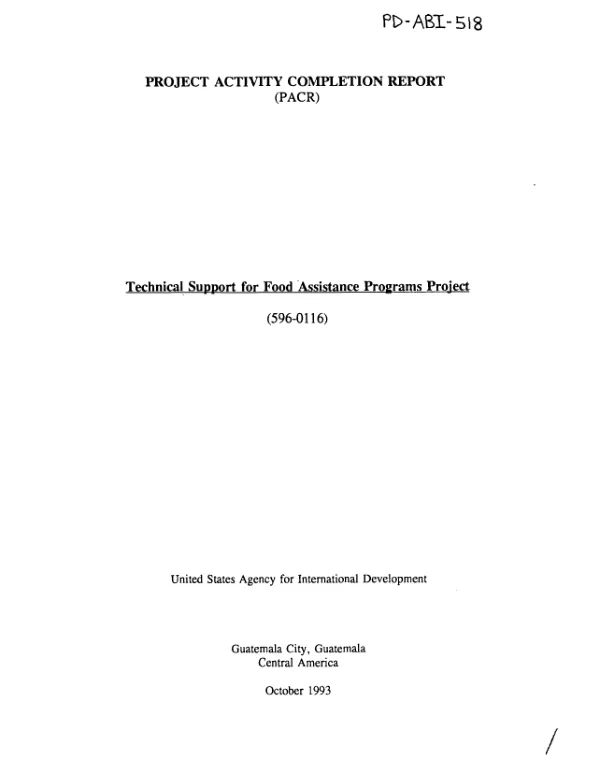
Project activity completion report (PACR) : technical support for food assistance programs project (596-0116)
Sign inUSAID. BUR. FOR LATIN AMERICA AND THE CARIBBEAN. REGIONAL OFC. FOR CENTRAL AMERICAN PROGRAMS (ROCAP)
Project activity completion report (PACR) : technical support for food assistance programs project (596-0116)
PACR of a project (FY85-10/93) to improve the effectiveness of food assistance activities in Central America and Panama by establishing national coordination mechanisms and by upgrading the capacities of the Nutrition Institute of Central America and Panama (INCAP) and of national public and private agencies.
1993
Sign in to readA free account is required to download.
Abstract
Despite a delayed start-up, inadequate host government and agency commitment, and shifts in U.S. policy, the project produced nearly all of its planned outputs as well as some that were unplanned. In the planning and coordination component, nearly all of the regional meetings, workshops, and task forces were held. In the training and information component, targets for TA to INCAP were met or surpassed, while under the research component, most planned studies and assessments were carried out. Unplanned outputs included the development of food security strategies or policies in five countries, institutional assessments, special studies and evaluations on maternal/child health and targeted consumer subsidy programs, the development of a methodology for conducting operations research methodology at the strategic level, surveys of the nutritional impact of structural adjustment, and improved methodologies for studying food consumption. As a result of the project, INCAP has become the provider of choice for governments needing food program TA. It has broadened its contacts with international food and nutrition improvement efforts, begun building a reputation outside of the region, and demonstrated to those involved in food aid programs the value of interorganizational cooperation. In addition, government officials have increased their awareness of developmental role of food aid, and technical food aid staff in all participating countries have improved their food aid management skills. The following lessons were learned. (1) The levels of commitment among the government, donor, and implementing agency are not always equal but should be kept high if food aid technical support projects are to meet their goals. (2) Long-term advisors should begin working as soon as possible after project start-up if they are to develop the trust needed to be included completely in project activities. (3) Flexibility is critical when working with a resource such as food aid, which can be used in so many ways, and within a dynamic political and social environment. (4) When food programs are not implemented as designed, it is preferable to carry out process evaluations and improve the programs accordingly than to carry out impact evaluations. (5) The focused multidisciplinary project team approach to implementation is dynamic and highly productive for this kind of project. (6) Video documentaries, filmstrips, and slide shows on food programs are a major support to advocacy and training programs. (7) A balance between country and regional approaches for specific activities enhances the effects of a project such as this. (8) Ultimately, food aid programs will become effective only when they are operated effectively at the community level.