USAID DEC
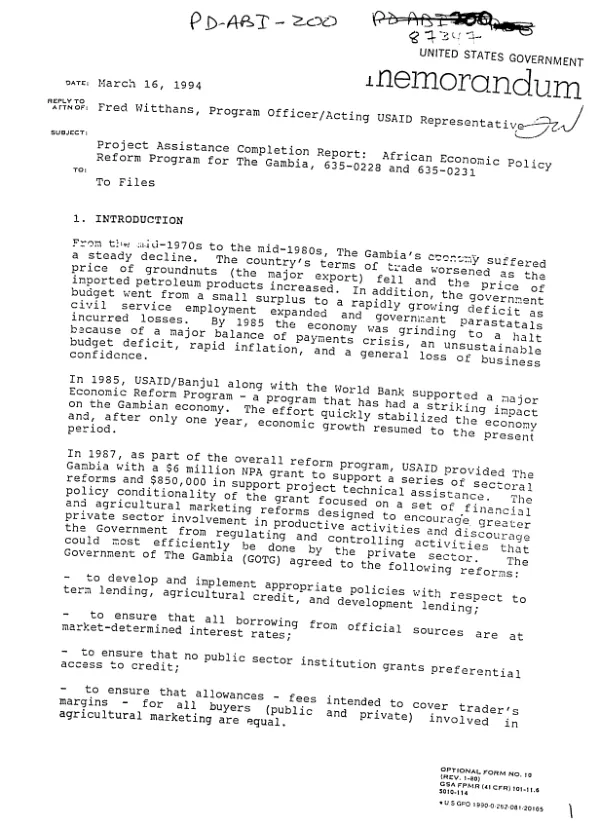
Project assistance completion report : African economic policy reform program for The Gambia, 635-0228 and 635-0231
Sign inUSAID. MISSION TO THE GAMBIA
Project assistance completion report : African economic policy reform program for The Gambia, 635-0228 and 635-0231
Presents final Mission report on the African Economic Policy Reform Program for the Gambia (1987-9/93).
1994
Sign in to readA free account is required to download.
Abstract
The program, and its complementary grant, focused on a set of economic and agricultural marketing reforms to encourage more private sector involvement and public sector disinvolvement in productive activities. The program succeeded in that the Gambia Cooperative Union (GCU) no longer receives preferential access to credit at below market rates, nor does it receive a preferential allowance for purchases of groundnuts. All commercial bank loans are now made at positive real rates of interest, thus encouraging savings and stemming capital flight. Nonetheless, private traders have not captured a greater portion of the domestic groundnut market, for two reasons. First, the marketing allowances, although equal, were too low. Private traders had trouble covering their costs, while the GCU simply went further into debt. Second, private traders had to pay their loans on time and finance their operations from their own funds while the GCU was allowed to accumulate a large debt at the Gambia Commercial and Development Bank (GCDB) without making payments on it in a timely manner. The program has taught some important lessons. (1) Donor coordination is essential, but split donor staffing of a management team can lead to problems. In this case, the World Bank funded the managing director position at GCDB, while USAID funded a controller and a computer specialist, who often disagreed with the director's policies. (2) Policy reform programs need the intensive services of highly skilled professionals (both host country and donor). (3) Designers should be sensitive to the phenomenon of interlinked markets. One important reason the GCU can retain its share of the groundnut marketing business is that agricultural input and output markets are closely linked in The Gambia. Farmers are inhibited from dealing with private traders out of fear that the GCU will deny them access to credit, seed, and fertilizer. (4) The effects of a complex policy reform program do not emerge quickly, and their causes are often difficult to determine because other influential changes are occurring at the same time. The reforms achieved under this program provided the foundation for two other USAID/G programs -- the Financial Restructuring Program (6350233/0234) and the Financial and Private Enterprise Development Program (6350232/0237) -- both of which have significantly enhanced private sector growth.
Related documents
Documents in this collection
 1995
1995USAID DEC
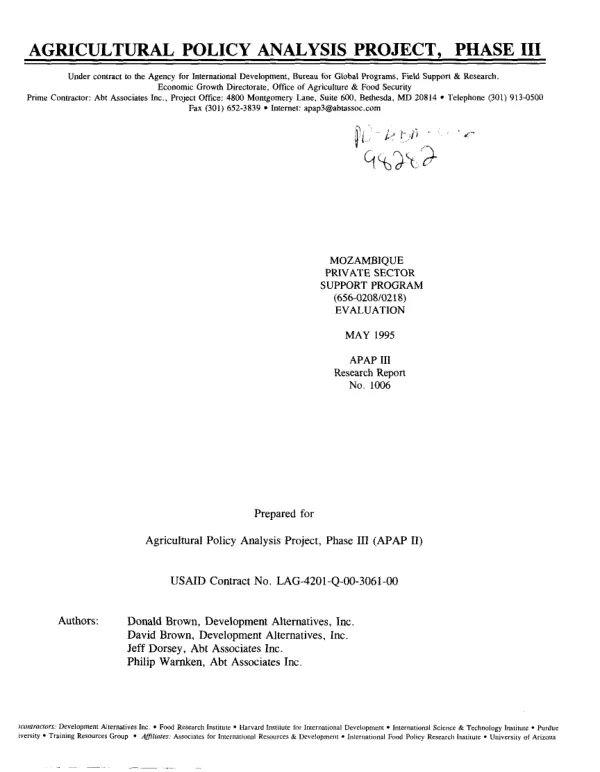
Mozambique private sector support program (656-0208/0218) evaluation
Open record 1990
1990USAID DEC