USAID DEC
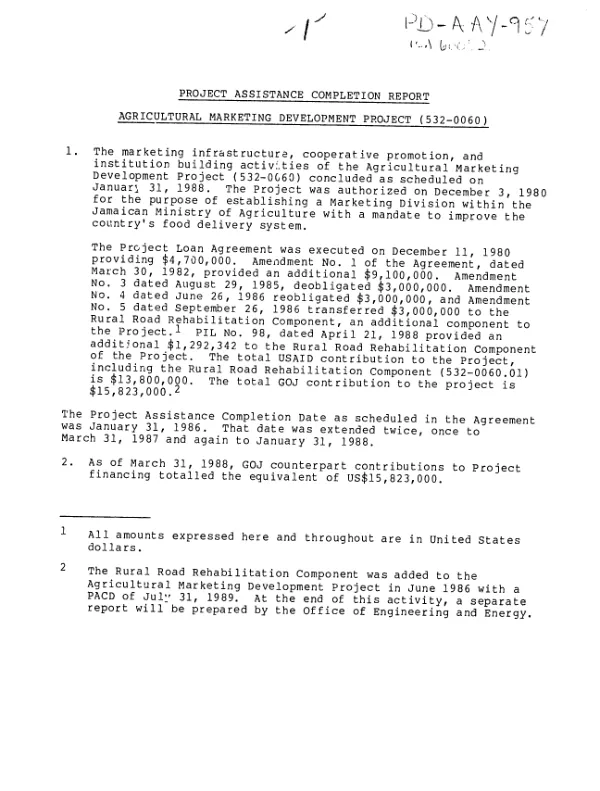
Project assistance completion report : agricultural marketing development project (532-0060)
Sign inUSAID. MISSION TO JAMAICA
Project assistance completion report : agricultural marketing development project (532-0060)
PACR of a project (12/80-1/88) to improve the efficiency of agricultural marketing in Jamaica.
1988
Sign in to readA free account is required to download.
Abstract
The project was executed in 2 phases, the first focusing on developing a marketing division within the Ministry of Agriculture (MOA) and promoting cooperative Producer Marketing Organizations (PMO's), and the second funding the construction of markets and assembly/grading stations. Other activities have included fruit fly trapping, a citrus canker survey, and a road improvement component, the latter added in 6/86 with a 7/89 PACD. The project was plagued with implementation problems from the outset. Some were typical of large, complex institutional development projects, while others can be attributed to the Government of Jamaica's (GOJ) failure to provide scheduled counterpart funding, particularly for construction, and to cumbersome GOJ contracting procedures. During the first 5 years, only 1 assembly/grading station was built (vs. 25 planned), and the appropriateness of that facility is doubtful, given the volume of produce marketed by the PMO that operates it. A plan to construct a commercial slaughterhouse was not carried out because the implementing agency failed to identify an appropriate construction site and contract an operator. TA proved a problem rather than an asset. The first team of advisors to the MOA marketing division were particularly unresponsive to project needs: one member prepared specifications for the procurement of processing/storage equipment (costing $755,422) totally inappropriate for the PMO's, which were then at their earliest stages of development. Fortunately, however, the equipment has since been put to good use at a winter vegetable processing facility. More positively, after expansion of the TA component in 1/85, a U.S. Department of Agriculture inspector was assigned to preclear and supervise the fumigation of produce exported to the United States. Equipment for a GOJ fumigation facility and training of MOA personnel were also provided. This activity has made an important contribution to facilitating the export of nontraditional products, and has since been incorporated into another A.I.D. project to ensure continued funding. Several lessons were learned. (1) Cultural and historical factors should be considered early in the design process. Had this been done, more than 5 years and many millions of dollars would not have been expended in a futile effort to substitute a wholly inappropriate U.S. marketing model for one that had developed locally for over 200 years, and which is still entirely appropriate in the Jamaican context. (2) An efficient agricultural marketing system is characterized by open competition, well-informed participants, and minimal price distortions. This project failed to emphasize these characteristics by concentrating on market infrastructure construction and cooperative promotion. (3) Project management must be alert to delays in the execution of activities and make necessary modifications, including timely reprogramming. (4) Planning and budgeting in the project design process must be realistic.
Related documents