USAID. MISSION TO JAMAICA
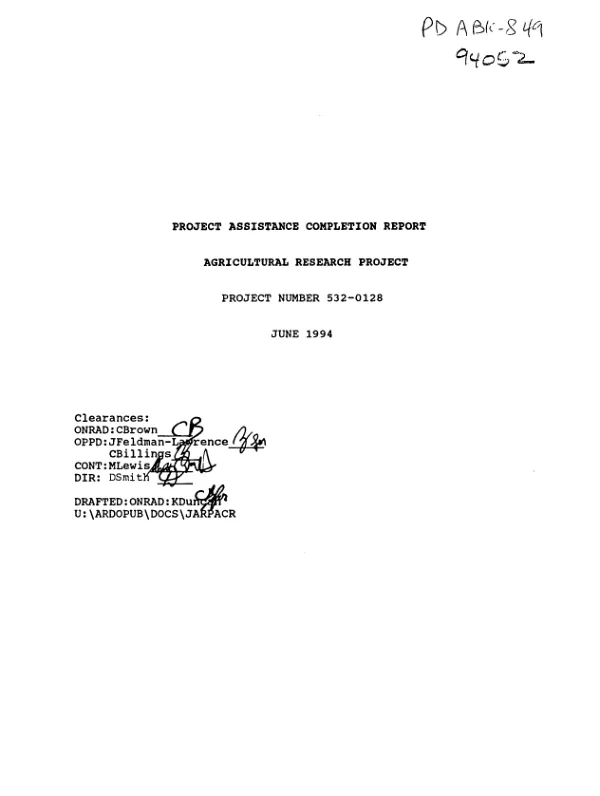
Project assistance completion report : agricultural research project
PACR of a project (7/86-12/93) to establish an autonomous Research Advisory Council (RAC) to sponsor research on problems constraining the production of priority crops in Jamaica.
1994
Sign in to readA free account is required to download.
Abstract
The project was implemented by the Jamaica Agricultural Development Foundation (JADF). The research efforts sponsored by the project have contributed valuable information for improving the efficiency of Jamaican agriculture. While not all have produced results that can be immediately transferred, they have identified limitations or other research activities that could lead to the solution of problems now limiting productivity. Specific accomplishments include, inter alia: (1) significant increases in production and export of ornamental flowers and orchard crops, including anthurium and papaya; (2) adoption and commercial export development for blast freezing and vacuum packing of breadfruit and ackee; (3) introduction of new water aeration techniques in fish ponds to increase stock densities; (4) adoption of micro-irrigation systems on small-scale vegetable farms in the Rio Cobre Basin; (5) research on the forage value of African Stargrass, which is now being used by one of Jamaica's largest dairy producers; and (6) creation in St. Thomas of 10 orchid farms which have become a cooperative and have launched a self-financed second phase of the project. Postgraduate training of 50 persons, 37 of them Jamaicans, contributed to the pool of skilled personnel needed for an effective research system. Unfortunately, due to Jamaica's lack of a long-term agricultural research program, there are few employment opportunities for these trainees, although at least 10 have been hired by successor research programs in which JADF is involved. Also, JADF has set up an endowment of J$10 million to support commercial agricultural production and research. The following lessons were learned. (1) The sustainability of the project was compromised by its neglect of the Ministry of Agriculture and other public sector agricultural research resources. Agricultural research sustainability should have been a prime concern from the outset. (2) Although training emerged as a critical element, it was not adequately addressed at the outset. In a country like Jamaica, lack of a large and well-trained agricultural research community is a preeminent constraint. (4) A grantee institution must not delegate full fiscal responsibility for a foreign donor grant to a subsidiary NGO. (5) If agricultural research is to continue in Jamaica, it will require initiatives in two general areas. For simple adaptive research questions, key factors include a strong public sector role combined with extension from commodity groups such as the parastatal commodity boards. For more technical and complex research questions, a strong partnership between government and food processors, large agricultural estates, and even foreign private agribusiness will probably be key.