USAID DEC
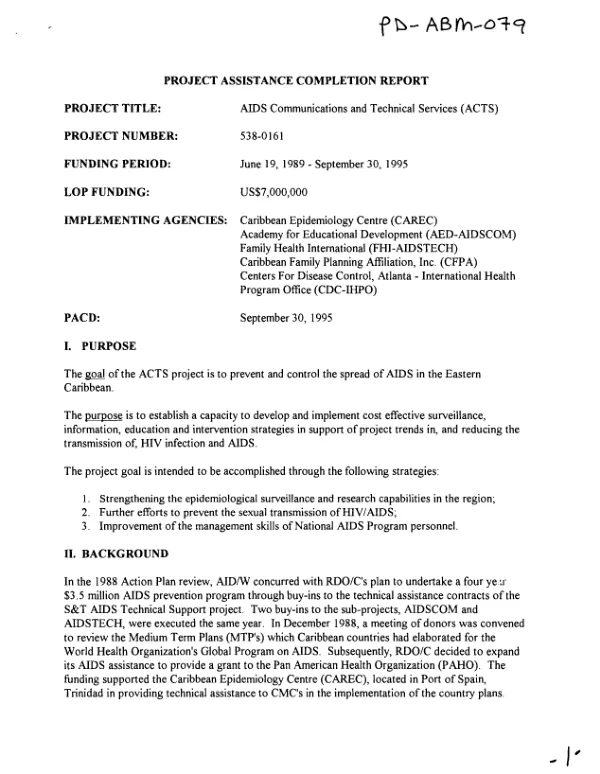
Project assistance completion report : AIDS communications and technical services (ACTS) -- June 19, 1989-September 30, 1995
Sign inUSAID. BUR. FOR LATIN AMERICA AND THE CARIBBEAN. REGIONAL DEVELOPMENT OFC.
Project assistance completion report : AIDS communications and technical services (ACTS) -- June 19, 1989-September 30, 1995
PACR of a project (6/89-9/95) to prevent and control the spread of AIDS in the Eastern Caribbean through surveillance, information, education, and intervention strategies.
1995
Sign in to readA free account is required to download.
Abstract
The project was implemented by the Caribbean Epidemiology Centre (CAREC). The project has made significant progress in preventing and controlling the further spread of AIDS in the Eastern Caribbean. It has helped to establish national and regional HIV/AIDS/STD surveillance data collection systems, and helped participating Ministries of Health to develop a capability for tracking HIV/AIDS/STDs. These efforts have contributed to the development of educational programs and multi-media public campaigns, which have increased the population's awareness of HIV/AIDS/STDs and the risk they pose to society. Unfortunately, there remains a good deal of misunderstanding about the disease, and in fact the majority of people living with HIV/AIDS are being ostracized by their communities. The project has also provided National AIDS Program staff in each participating country with training in planning, program development, and evaluation and costing methodologies, and it has significantly strengthened CAREC as a regional leader in HIV/AIDS/STD research. The following lessons were learned. (1) The project design set CAREC up for failure by not giving it the authority needed to direct the numerous agencies contracted to support its efforts. (2) The project tried to accomplish too much in too short a time with too little expertise, and as a result, had to rely on outside agencies to accomplish its objectives. (3) Close monitoring of the project's activities and progress and the use of what little leverage was available allowed RDO/C to refocus CAREC's project activities and to make the most of the project's final year. (4) The stronger emphasis on behavioral interventions recommended for phase II did not materialize; more effective follow-up was required in assuring that technical resources of the U.S. Centers for Disease Control would be available to CAREC when requested. (5) Although sufficient TA was provided under the project in the form of regional training, more follow-up at the community level would helped to consolidate gains in individual countries. (6) Donor cooperation in the evaluation of similar or complementary project activities can lead to more effective results and insights than a single agency working alone. (7) The role of technical consultants is not to make decisions for host-country personnel but to facilitate a process by which host-country personnel can make decisions for themselves.