USAID. MISSION TO MOROCCO
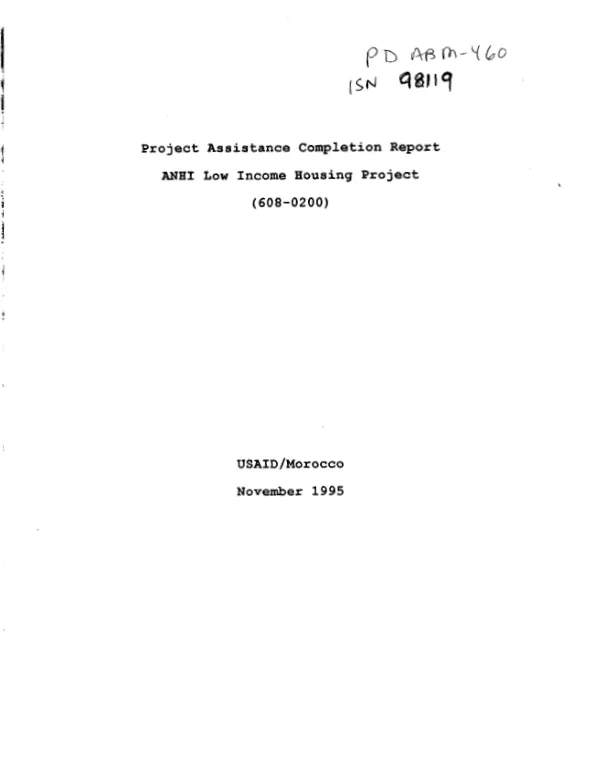
Project assistance completion report : ANHI low income housing project (608-0200)
PACR of a project (6/89-6/95) to assist the National Shelter Upgrading Agency (ANHI) in implementing a Housing Guaranty (HG) program for low-income families in Morocco.
1995
Sign in to readA free account is required to download.
Abstract
The project was a success, but much remains to be done to solve the problems of Morocco's low-income housing sector. Despite its modest financing level, the project greatly benefited the HG program and ANHI as an institution. Access to short-term TA, computers, training, and funding for studies and seminars helped ANHI build its internal capacity and to work through issues of importance to itself and the sector. ANHI was successful in terms of producing serviced lots for housing, upgrading unserviced neighborhoods, and producing and selling lots for cross-subsidy purposes. Over the 6 years of the project, ANHI grew rapidly, both in staff and activities, and is now producing over 12,000 serviced lots per year (at times nearly 15,000 lots), after an initial period of a few hundred to 5,000. ANHI is now called on by sister agencies in the region to share its expertise as the lead residential land development agency in Morocco. The selection of ANHI by the United Nations Center for Human Settlements as recipient of the 1995 World Habitat Award for human settlements projects for a site developed under the auspices of HG-003, and with assistance through this project, is one more indication of success, which led USAID to approve a follow-on HG at four times the dollar value of this HG. With project help, ANHI increased the private sector's role in low-income housing provision. ANHI fully contracts all its works to the private sector and uses a variety of innovative means to increase the private sector's role at all stages of low-cost housing development. Nonetheless, the private sector's overall involvement in the low-cost housing sector remains limited. ANHI has kept down the cost of its low-income housing lots and has worked consistently to reduce costs overall. Further, the Government of Morocco (GOM) made policy changes during the life of the project which are helpful to ANHI, e.g., relaxation of certain rules usually imposed on parastatal operations, some concessions on zoning standards in ANHI-developed neighborhoods; these are due, in part, to the grant-financed studies and short-term TA. Nonetheless, the constraints to land development in Morocco, which include the limited role of the private sector, are substantial and complex, and the project did not solve them. They will continue to be matters for dialogue, by USAID, the World Bank, and other donors and lenders. The following lessons were learned. (1) The project design would have been stronger had it paid more attention to ANHI's long-term financial sustainability, although in 1989 such a focus might not have been an acceptable topic for GOM decisionmakers, who maintained tight controls over ANHI as a parastatal agency. (2) The project differed from most bilateral projects in that it was managed by USAID rather than by an institutional contractor. The reliance on short-term interventions and multiple Mission-managed contracts allowed flexibility and hands-on experience for Mission housing and urban development professionals (who took a direct role in many project activities and in policy dialogue), but was a management burden for the Mission; the follow-on project will require a central institutional contract, although the its structure will be similar to the current project. (3) Program/project design was ambitious, and the policy agenda was beyond the management capacity of ANHI and USAID. However, it is always easy to criticize selection of policy dialogue topics in retrospect (a lesson learned from USAID's policy-based cash transfer programs). If designers in this case erred, it was perhaps in appearing too confident that the various GOM agencies would agree on changes recommended by outside experts (and that such changes could be effected without major legal changes). Those policy issues which are deemed still important are to be pursued in the follow-on program/project, which will have a larger budget and a more modest policy agenda than this project. (4) The HG program was different from earlier HG programs in Morocco, which reimbursed the Ministry of Housing for construction of core housing units for the poor. The project, which was similar in nature to TA packages attached to cash transfer programs in many countries, did not stand on its own, but supported the HG program.