USAID DEC
Project assistance completion report : Antigua water supply project, AID project no. 538-0098, AID loan number 538-K-023
Sign inUSAID. BUR. FOR LATIN AMERICA AND THE CARIBBEAN
Project assistance completion report : Antigua water supply project, AID project no. 538-0098, AID loan number 538-K-023
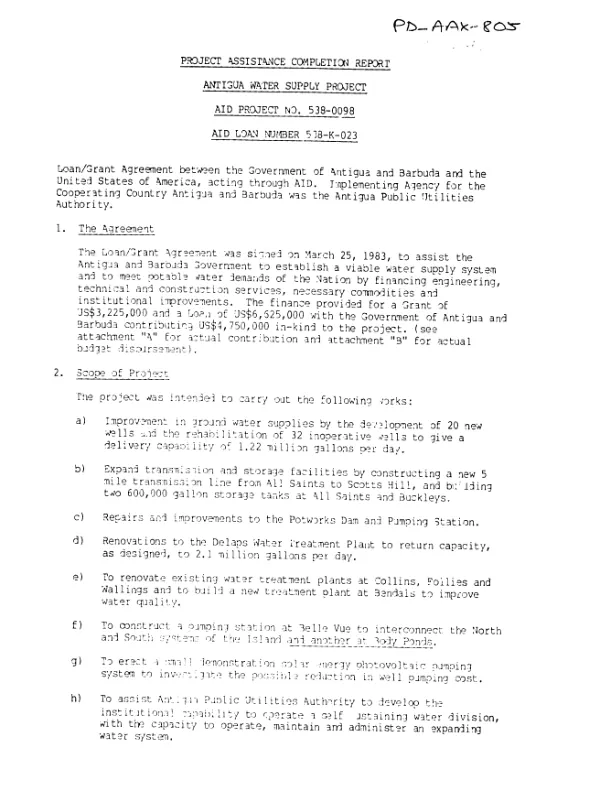
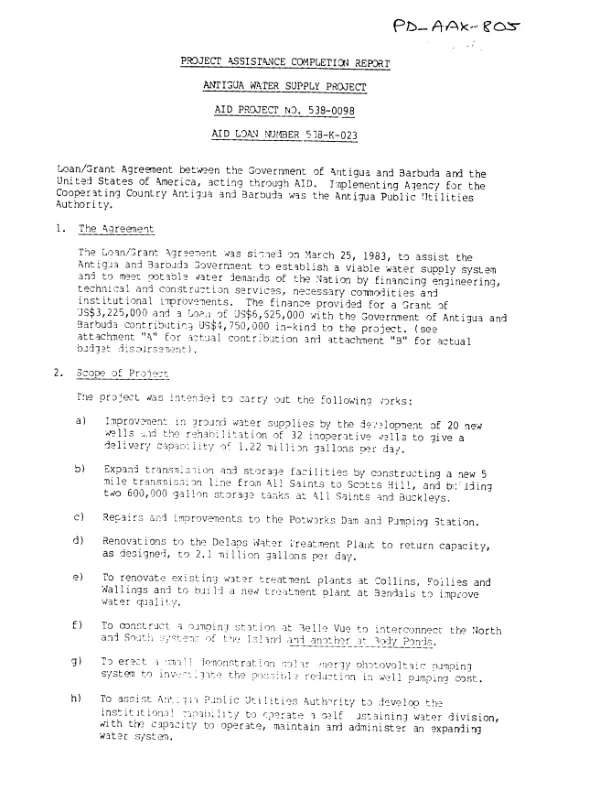
PACR of project (3/83-3/88) to establish a water supply system to meet national potable water demands in Antigua and Barbuda and to provide TA and training to the Antigua Public Utilities Authority (APUA) to ensure system maintenance and future expansion.
1987
Sign in to readA free account is required to download.
Abstract
In 1984, when the construction phase of the project began, Antigua was facing a drought of disaster proportions - fresh water was being barged to the island from Dominica and Guadeloupe. As a result, initial priorities were placed on developing new groundwater reserves and rehabilitating existing wells. APUA personnel were trained to drill exploratory and new wells, and 21 wells were rehabilitated and 26 new wells developed. Total groundwater capability is now 1 mgpd, and average production is 900,000 gpd. In addition, water pipelines, treatment plants, pumping stations and related structures were built and rehabilitated, including among others a 16-inch transmission line from the storage tank at All Saints to Scotts Hill, two 600,000 gallon storage tanks at All Saints and Buckley, and an experimental solar pumping station, which pumped 5,000 gallons per day until its solar cells were damaged, apparently by vandals. As part of the institution building side of the project, an organizational chart for the water division of APUA was developed, and job descriptions were prepared for each position. An accounting system was installed, operating procedures were developed for procurement, budgeting, and planning, and a number of APUA employees attended regional seminars on a variety of water quality and management issues. Timing is a crucial element in project design, and in too many cases the consultant's estimate of the time required to complete the project is based on North American conditions. Unfortunately, in developing countries, remoteness from manufacturers and less than ideal infrastructure can add significantly to implementation time. It can take up to six months for materials ordered from overseas to arrive. Engineering also takes longer than expected, as consultants have to learn about local conditions. This delays right-of-way acquisitions, which in themselves can take up to a year. Since TA contracts are budgeted on a time basis, these delays could mean that the budget could run out just when construction is able to start. It is essential that project design realistically estimate PACD's. Other lessons are (1) project budgets must assign realistic values for contingency expenses; (2) time must be allowed for maintenance and operation training; and (3) all parties in a project should be aware of conditions precedent and their financial obligations and abide by them - too often, these are glossed over in everyone's haste to get a project underway.
Related documents
Documents in this collection
 1970
1970USAID DEC
Project assistance completion report : Antigua water supply project, AID project no. 538-0098, AID loan number 538-K-023
Open record![Final evaluation, operational program grant USAID 879-0251-G[-]SS-1005-00 : Ha'apai water supply project, Kingdom of Tonga, June 30, 1981-August 31, 1986](https://covers.devme.ai/gen/10279.webp) 1986
1986USAID DEC