USAID DEC
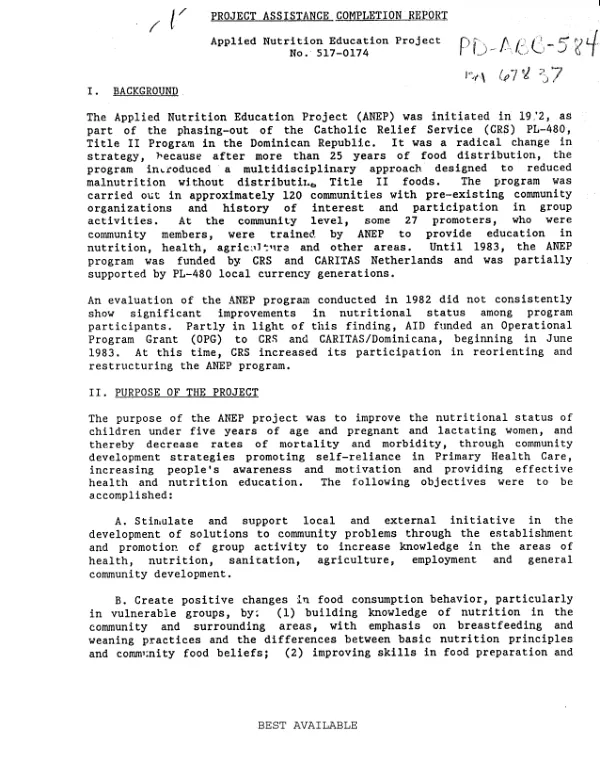
Project assistance completion report : applied nutrition education project, no. 517-0174
Sign inUSAID. MISSION TO DOMINICAN REPUBLIC
Project assistance completion report : applied nutrition education project, no. 517-0174
PACR of a project (1983-1988) to improve maternal/child nutrition in the Dominican Republic through growth monitoring and nutrition education activities.
Sign in to readA free account is required to download.
Abstract
Catholic Relief Services (CRS)/Caritas implemented the project. As a result of project activities, the prevalence of child malnutrition in the targeted communities dropped from 12.2% to 5.4% between 9/84 and 9/87. This success is attributed primarily to the project's grassroots, participatory approach which utilized consciousness-raising, individual and community motivation, and the promotion of self-reliance and individual initiative. Additional strengths included appropriate selection of participating communities and personnel, continuous supervision, technically well-defined and integrated activities, an effective communication strategy, and a simple and efficient information system for surveillance and evaluation. A total of 8,798 children benefitted from the program. To help promoters provide sound advice during growth monitoring home visits, a series of illustrated nutrition messages, reinforced by flyers, were produced. Four mini-workshops and 10 radio jingles were also produced. The materials were well accepted and contributed to behavioral changes of most mothers, though it appears that the highest-risk children are in the upper brackets of the target group (children 0-5). New materials need to be developed to address the needs of these older children. On the negative side, community works activities (e.g., water, sanitation, and gardens) were less than successful due to insufficient financial resources and litle support received by area supervisors. Community income-generating activities funded through project loans were also unsatisfactory: of ten such activities, only two were successful. A major lesson learned is that it is more cost-effective to prevent malnutrition through growth monitoring than to cure it. The growth monitoring process also provides families with nutrition education which increases the mother's and family's capacity to make health care decisions. Finally, efforts to decentralize the project were only partially successful, and should be given higher priority now in the interests of program sustainability.