USAID. MISSION TO BURUNDI
Project assistance completion report : Bururi forest project (695-0105)
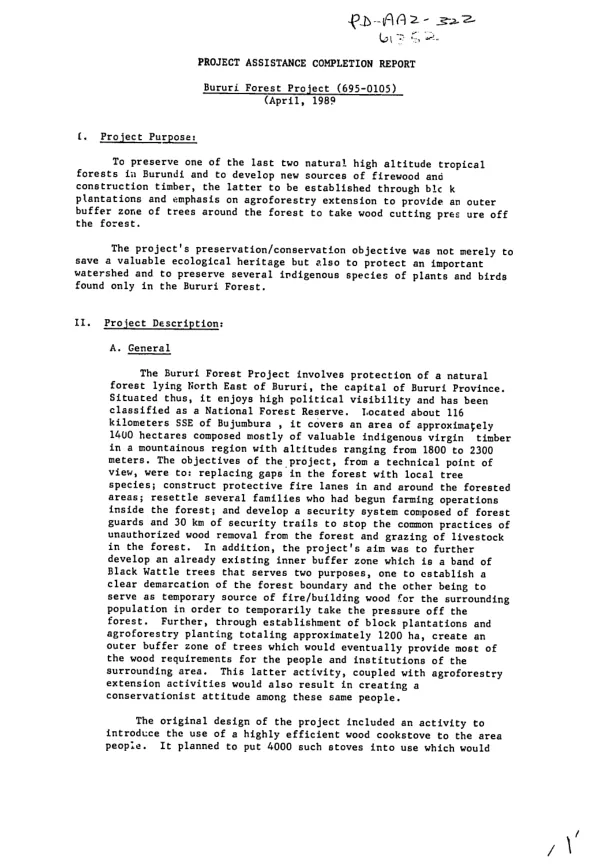
PACR of a project (9/82-6/88) to establish block plantations as a buffer zone around one of the last two natural high altitude tropical forests in Burundi and as a source of firewood and construction timber.
1989
Sign in to readA free account is required to download.

Abstract
The goal to protect 1,400 ha of natural high altitude forest has been 90% achieved. However, this protection has come somewhat at the expense of households surrounding the forest which normally satisfied their firewood and building needs from the forest. It will take another 9-10 years of growth before the plantings will provide significant amounts of wood, while efforts to reduce the demand for wood had little success. For example, the project assumption that peat development would result in 60% of households utilizing peat as fuel did not materialize. This was attributed to distribution problems and women"s preference for wood, which is often gathered free of charge. Furthermore, an activity to introduce more efficient wood stoves encountered myriad logistical problems and was abandoned. Both the TA and training components needed to be expanded. Instead of a part-time forestry advisor working 2 months per year, the project hired a long-term (2 year) advisor. Training was augmented to include long-term U.S. training to compensate for the inexperience of the project"s administrative entity, the Institut National pour la Conservation de la Nature (INCN), which early on replaced the Department of Water and Forests as the implementing agency. The first participant completed a B.S. in Forestry/Agroforestry in 6/88. The sustainability of the project depends largely on the success of the agroforestry activity to replant deforested areas. This aspect of the project purpose can be realized only in the long-term and only with continued support from INCN and the Government of Burundi.