USAID. MISSION TO ECUADOR
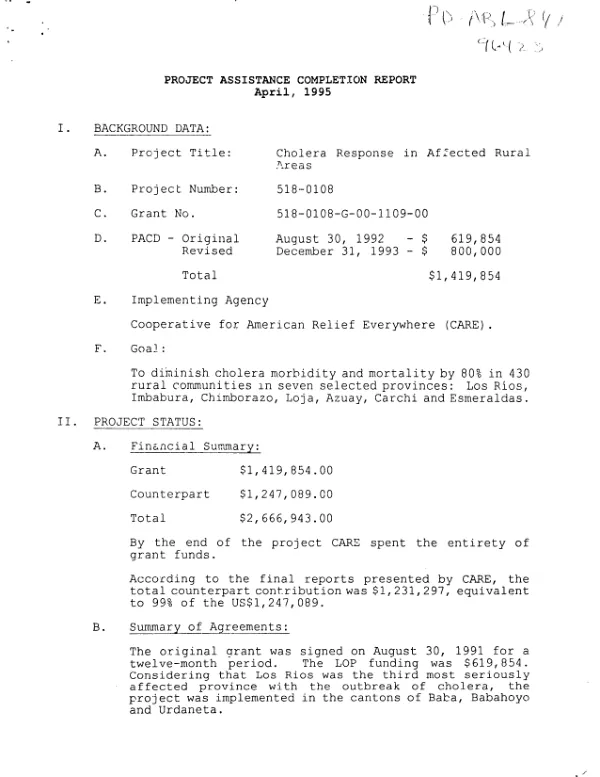
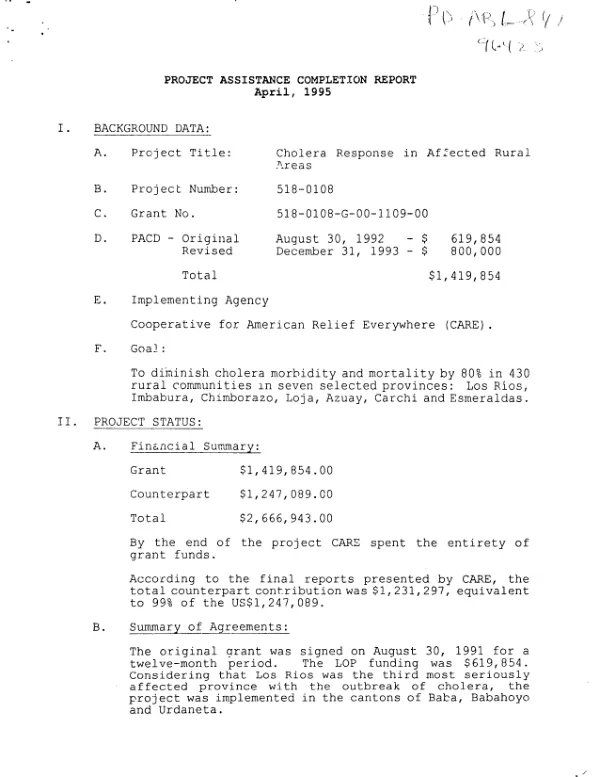
Project assistance completion report : cholera response in affected rural areas
PACR of a project (8/91-12/93) to diminish cholera morbidity and mortality by 80% in 430 rural communities in seven provinces in Ecuador: Los Rios, Imbabura, Chimborazo, Loja, Azuay, Carchi, and Esmeraldas.
1995
Sign in to readA free account is required to download.
Abstract
The project was implemented by CARE. The project consisted of three major components: latrine construction, hygiene education, and a mass media campaign. Under the first component, CARE provided ventilated improved pits to communities with no gravity-flow water system, waterseals to communities with water systems, and raised, sealed pits to communities in the flood plain. CARE provided 40% of construction materials, the Ecuadorian Institute of Sanitary Works (IEOS) demonstrated construction and provided supervision, and communities dug pits, built latrines, and provided 60% of the construction materials. Under the second component, CARE taught community members to wash hands with soap after using the latrines, boil or chlorinate water before drinking it, cook and protect all food well, bury excreta, preferably in latrines, and use sugar-salt and rehydration salt solutions. CARE also reinforced the practice of breastfeeding. The third component, a mass media campaign, was essential to broadcast educational programs in all targeted provinces. During its extension period, the project built six water systems in four provinces: Carchi (Mira), Imbabura (Cotacachi), Chimborazo (Riobamba), and Los Rios (Ventanas and Baba). The project exceeded all of its major targets: 40,170 (vs. 28,500) latrines were built and families trained, and 571 (vs. 400) Community Oral Rehydration Units (CORUs) were established. While no concrete evidence of impacts on mortality was found, it can be expected that changes will occur in the future, given improved hygiene behavior. In sum, activities carried out by CARE were very much a response to the cholera outbreak. Evaluation findings as well as testimonials from community leaders and Ministry of Health officials point to the importance of CARE's contribution. Cholera has passed the epidemic stage in Ecuador and entered the endemic stage; CARE's activities have now been extended into other endemic areas under the Water and Sanitation for Health and Ecuadorian Development (WASHED) project. The following lessons were learned. (1) The cholera epidemic, which took Ecuador by surprise, was successfully handled by a number of institutions. Critical to this success was the coordination among institutions, including CARE, which made the interventions of each much more effective. (2) CARE's model of integrating construction with hygiene education is critical to the sustainability of sanitation construction programs. The model is employed by other USAID projects and should be promoted among other donors, such as the World Bank and Inter-American Development Bank. (3) While cholera has entered its endemic stage in Ecuador and emergency programs are no longer necessary, child survival and other health programs should continue to focus on reducing the underlying causes of cholera, which include poor water and sanitation services, high incidence of diarrheal disease, and poor access to adequate health services.