USAID. MISSION TO DOMINICAN REPUBLIC
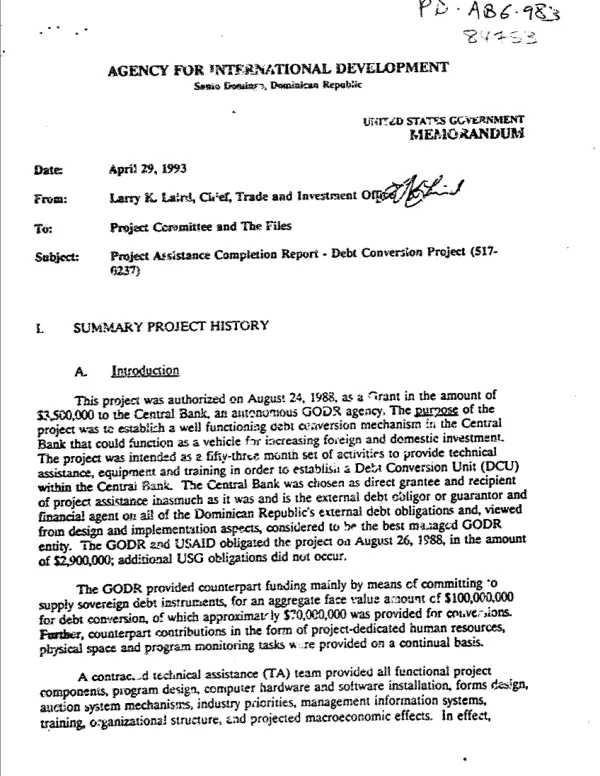
Project assistance completion report - debt conversion project (517-0237)
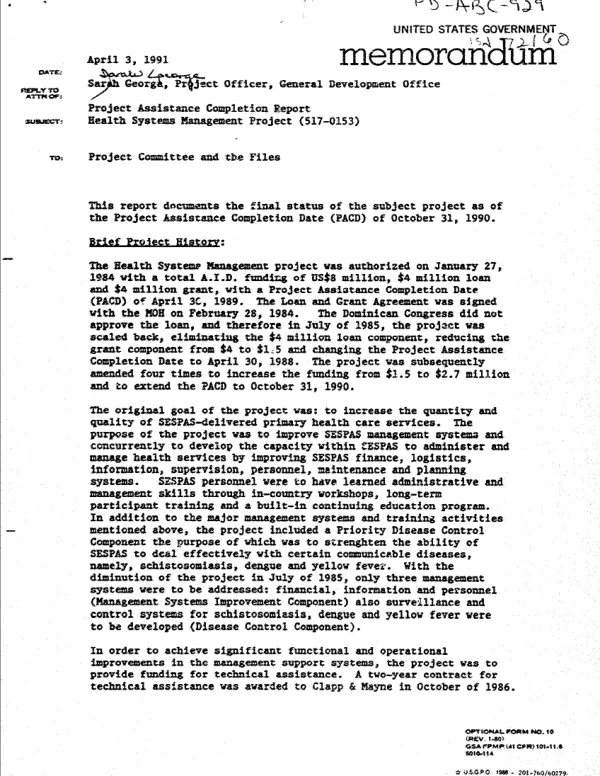
PACR of a project (8/88-12/91) to establish a debt/equity conversion mechanism within the Central Bank (CB) of the Dominican Republic as a vehicle for increasing U.S.
1993
Sign in to readA free account is required to download.
Abstract
and domestic equity investment. Project implementation was delayed until 4/90 because the CB was slow to commit to the project, and because of difficulty in obtaining amendments to the commercial bank credit agreements allowing the initiation of debt reduction programs. Nonetheless, the project did establish and train a Debt Conversion Unit within the CB, and provided training to 15 other CB personnel. Eighteen debt conversion projects have been completed (vs. 30 targeted) in the following broad investment categories: tourism (5); environment and social development (3); commercial bank recapitalization (4); and commercial and industrial uses (6). The projects resulted in a tendering to the CB of almost U.S. $70 million in external debt instruments, or 1.7% of the Dominican Republic's average outstanding external debt as of 5/31/90. On the broader issue of external debt strategy, the TA team helped the Dominican Republic to re-establish open communications with commercial banks, the IMF, and other external creditors, culminating in an IMF economic program in 8/91. The team was also instrumental in bringing about an 11/91 debt restructuring agreement with the Paris Club group of official creditors (the project's most significant accomplishment). The team also helped the Dominican government to identify options for debt renegotiation based on information from recent U.S. Treasury (Brady Plan) debt restructurings with other Latin American countries, but no renegotiation has yet been done. The TA team prepared sensitivity analyses, which the government presented to the San Jose Accord creditors (Venezuela and Mexico) and used to repurchase, at a significant discount, approximately $500 million in past due loans. This transaction offered the Dominican government the chance for new petroleum credits from these two main suppliers. All of this was done so that the government could enter into a new debt agreement with the commercial banks that would allow debt conversion using lender bank debt instruments. The following lessons were learned. (1) The project had to accommodate the significant variations in the approaches of 3 CB governors; careful judgment was needed to determine how their attitudes could be accommodated. (2) Since debt conversion is dependent on the larger issue of debt restructuring, the project design could have focused TA on external debt consultation. (3) The management information systems support was greater than the volume of operations warranted. A more basic installation would have sufficed. (4) Debt conversion projects should: (a) have A.I.D. Legal Counsel review debtholder documentation to ensure that debt conversion or other debt reduction is permitted; (b) coordinate with the U.S. Treasury, which monitors the debt status of restructuring countries; and (c) consider funding integrated external debt advisory services.
Related documents
![Project activities completion report : commercial farming systems project (517-0214) [- Agricultural Development Foundation component]](https://covers.devme.ai/gen/7705.webp)
![Project activities completion report : commercial farming systems project (517-0214) [- Agricultural Development Foundation component]](https://covers.devme.ai/gen/67082.webp)