USAID DEC
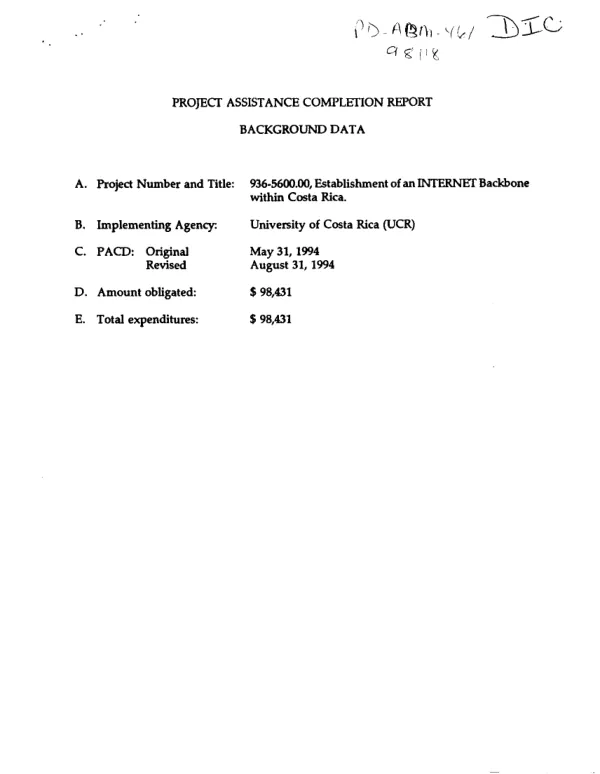
Project assistance completion report : establishment of an Internet backbone with Costa Rica
Sign inUSAID. BUR. FOR GLOBAL PROGRAMS, FIELD SUPPORT AND RESEARCH. OFC. OF RESEARCH
Project assistance completion report : establishment of an Internet backbone with Costa Rica
PACR of a project (5/92-8/94) to establish an INTERNET Backbone within Costa Rica to link the scientific and technological communities in Costa Rica and other countries in Central America to their counterparts around the world.
1993
Sign in to readA free account is required to download.
Abstract
The project was implemented by the University of Costa Rica (UCR) in collaboration with the University of Wisconsin-Madison (UW). The project accomplished its main targets and in some cases surpassed expected goals. A 64 Kbps satellite INTERNET link (3 times faster than that planned) was put in operation in 1/93 and then doubled to 128 Kbps early in 1995. The first 12 institutions, including the Legislative Assembly, that were directly connected to the Internet under this project, created the National Research Network (CRNet), which is responsible for administering INTERNET services in both the academic and research sectors of Costa Rica. In all, 750 computer nodes were directly interconnected to the INTERNET at participating CRNet institutions, which now number 1,500 and cover all sectors. Particular efforts were made to work closely with the computer center heads at the CRNet member institutions on INTERNET technologies so that additional users at those institutions would be trained in turn. The CRNet organization model, established at the beginning of the project, is highly decentralized and distributed in physical and logical design, as well as in administrative and information aspects. Communication costs are now completely covered by local participating institutions. Regarding regional expansion, Nicaragua was connected to the INTERNET in 2/94 through CRNet, using a terrestrial microwave analog link between the two countries. A few months later, Panama was linked to CRNet, thereby connecting its major universities to the Internet. The total number of users is now estimated at 15,000. Local technicians at UCR have turned themselves into real experts. As it happened, the visit of the UW experts was postponed, so the local technicians, urged to solve the problems that normally arise in this kind of project, used the same Internet as a powerful instrument to receive advice from the UW counterparts. As a result, the visit of the UW experts never took place. The project is of major importance to Costa Rica's technological development; large-scale, state-of-the-art Internet work technologies have been introduced for the first time in Costa Rica and neighboring countries, and have spread to universities, research centers, corporations, and government. This is crucial for the competitiveness of Costa Rica and the Central American region, as lack of access to worldwide information would keep it at a disadvantage in an era of increasing globalization.
Related documents
Documents in this collection
 1996
1996USAID DEC
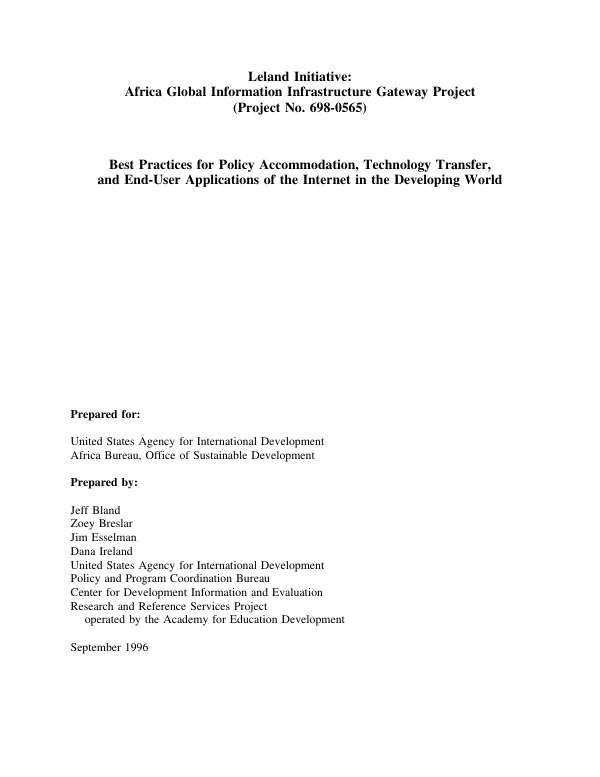
Leland initiative : Africa global information infrastructure gateway project (project no. 698-0565) -- best practices for policy accommodation, technology transfer, and end - user applications of the Internet in the developing world
Open record 1995
1995USAID DEC
![Impact through technology program : [final report, October 1, 2011-June 30, 2013]](https://covers.devme.ai/gen/97724.webp)