USAID. MISSION TO ECUADOR
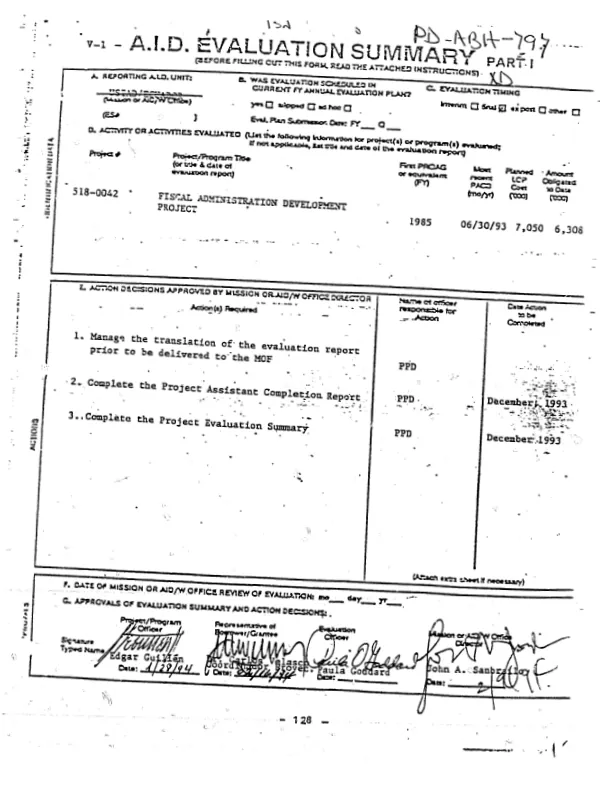
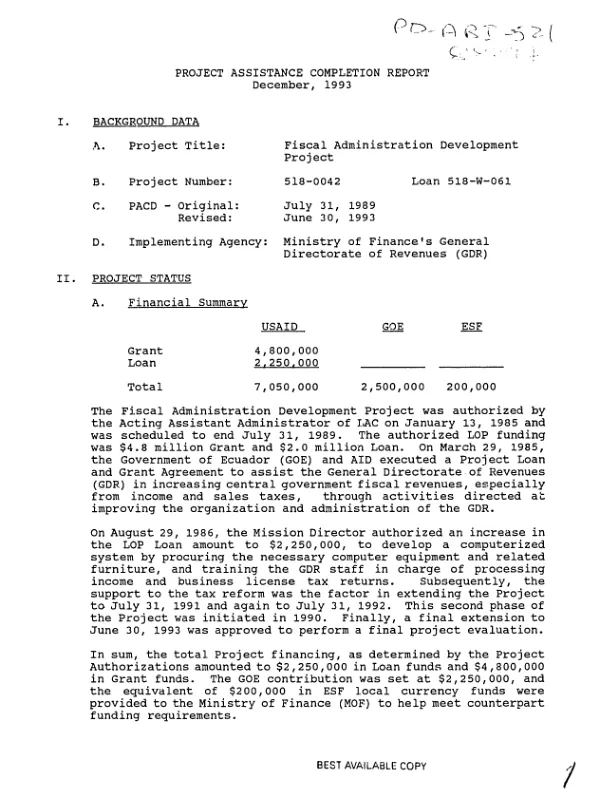
Project assistance completion report : fiscal administration development project
PACR of a project (1/85-6/93) to increase tax revenues, especially from sales and income tax, in Ecuador, and to strengthen the capabilities of the General Directorate of Revenues (GDR).
1993
Sign in to readA free account is required to download.
Abstract
Little progress was made during the first 3 years due to a delay in the reorganization of the GDR and the Government of Ecuador's (GOE) refusal to provide duty-free customs clearance for project commodities. However, the new GOE administration which took office in 8/88 responded positively to USAID/E's request for a recommitment to the project by initiating a rapid series of procedural changes; resolving the customs clearance problem; honoring a project obligation to add 20 collection agents to the GDR; passing legislation to expand the tax base, simplify tax collection procedures, and facilitate tax payment through the private banking system; and, finally, passing a comprehensive tax reform law. Despite these achievements, a final external evaluation showed largely negative results. The training of over 4,600 GDR personnel yielded little, since too many individuals were trained in areas not directly usable by the GDR. As a result, productivity failed to increase, and actually decreased in some critical areas. The situation was exacerbated by a lack of personnel incentives and the dismissal of 30% of the trainees, many of them tax collectors, when collections began to be implemented through the private banking system. Further, while the collections program was implemented successfully -- close to 100% of tax collection is now done through banks -- tax evasion remains high. In addition, the objective of improving the collection of delinquent accounts was not met; TA provided the data processing organization, constructive during Phase I, proved unsatisfactory during Phase II; computer equipment procured by different donors was often incompatible and is either not used or not used to capacity; and the Objective Global Assessment System created by the tax reform proved impractical and an open invitation to evasion. The projected increase (due to increased tax revenues) in public sector investment to 10% of GDP was never achieved. The project's failures resulted from a combination of factors, including resistance to change and a lack of leadership within the GDR, deficient TA from contractors, and lack of flexibility in adjusting to changing circumstances. The following lessons were learned. (1) Until the GOE places a high priority on tax collection and enforcement, donor funds for tax administration and reform will likely be underused. (2) Project implementation should take place in stages, with continuation subject to successive achievements of specific goals and continuous government support. (3) Focused training programs should be developed for key areas, but only if the GOE commits itself to increasing salaries for tax personnel. (4) In joint ventures among donors, there should a clear delineation of respective target areas and objectives. (5) The project should have developed, for fiscal analysis purposes, a tax computation model based on disaggregated information from tax returns. Such a model is badly needed in Ecuador.