USAID DEC
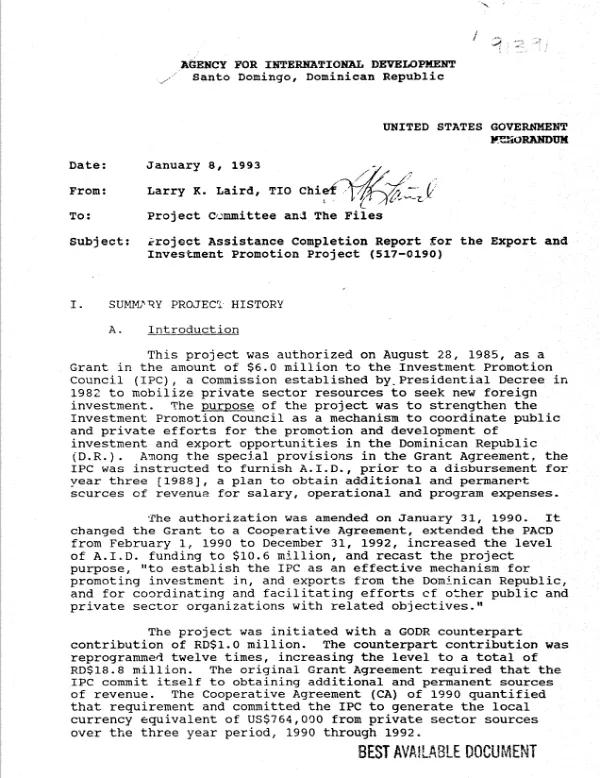
Project assistance completion report for the export and investment promotion project (517-0190)
Sign inUSAID. MISSION TO DOMINICAN REPUBLIC
Project assistance completion report for the export and investment promotion project (517-0190)
PACR of a project (1985-5/92) to establish the Investment Promotion Council (IPC) as a mechanism to coordinate public and private efforts to promote investment and export opportunities in the Dominican Republic.
1993
Sign in to readA free account is required to download.
Abstract
The project was highly successful in making the IPC into an effective agent for improving the Dominican business climate, promoting investment, and improving investor and exporter services. IPC's technical staff are highly competent, and its administrative and financial controls are gradually approaching acceptable standards. Even in activity areas that were only marginally responsive to the IPC initiative, e.g., customs services, heightened awareness brought about by IPC's interventions and public announcements triggered reform efforts which continue to be pressed forward by the private sector and some elements of the Government of the Dominican Republic (GODR). Specifically, IPC: (1) received grants from the World Bank, the Governments of Japan and the Republic of China, and the UNDP for policy and administrative reform studies; (2) proposed a modification (partially implemented by the GODR) in laws affecting the operations of firms with export potential in Free Zones and elsewhere; (3) contacted about 4,000 firms and induced 150 of them to invest a total of $120 million in the Dominican Republic, resulting in the direct generation of over 28,000 jobs; and (4) arranged export contracts with a total value of $14.9 million over the life of the project, resulting in the generation of some 5,500 jobs. The project had a number of shortcomings, however. Although the IPC had legally become a private institution, it remained dominated by government related interests and procedural norms. The administrative and financial practices of the new IPC were derived from those of the Ministry of Industry and Commerce. This was not consistent with the provisions of the grant agreement, and thus caused periodic suspension of A.I.D. disbursements and consequent programmatic delays. IPC's organizational and administrative problems distracted it from its intended role. Although it did make several sub-grants to private and public sector institutions and obtained cooperation from other private institutions for specific activities, it gradually became the sole implementing agency. Relationships with other institutions were ad hoc in nature. A lengthy delay in obtaining long-term TA also constrained project implementation. Ultimately, as members of the Association of Free Zones (ADOZONA) increasingly took over export promotion activities and as other, more effective institutions began addressing free market policy issues, it became apparent that IPC had outlived its usefulness and at its request the project was terminated on 5/15/92, against a PACD of 12/31/92. Lessons learned are as follows. (1) The successful achievement of investment and employment generation objectives was due to the ability of USAID and contract personnel to accurately monitor and assess project implementation and make the necessary mid-course modifications. (2) The degree to which accepted ways of thinking can be changed must be carefully gauged and monitored, especially where these modifications are essential to the achievement of the project purpose. (3) USAID and local participants must recognize that prior investment does not justify continued investment in projects that are no longer able to achieve their purpose.
Related documents
![Project activities completion report : commercial farming systems project (517-0214) [- Agricultural Development Foundation component]](https://covers.devme.ai/gen/7705.webp)
![Project activities completion report : commercial farming systems project (517-0214) [- Agricultural Development Foundation component]](https://covers.devme.ai/gen/67082.webp)