USAID DEC
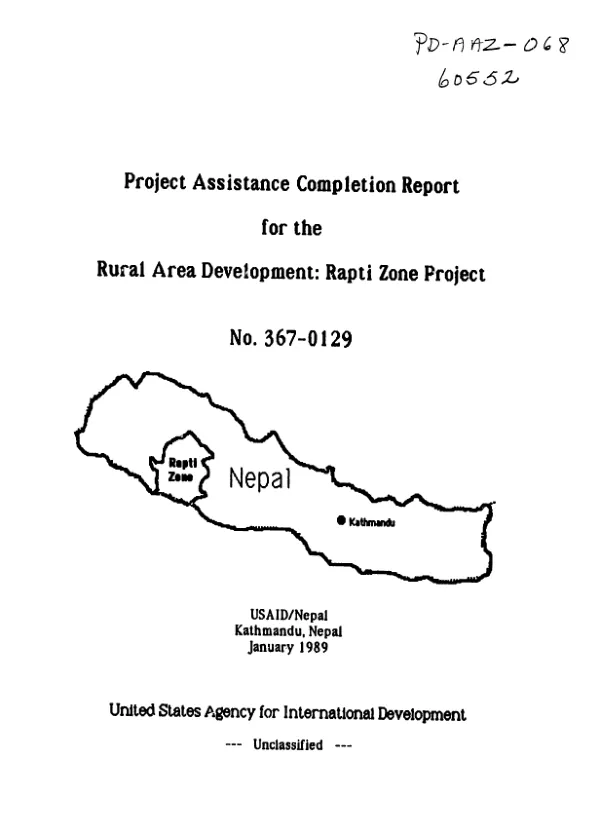
Project assistance completion report for the rural area development : Rapti Zone project no. 367-0129
Sign inUSAID. MISSION TO NEPAL
Project assistance completion report for the rural area development : Rapti Zone project no. 367-0129
PACR of Phase I of an integrated area development project (8/80-7/88) in Nepal's Rapti Zone.
1988
Sign in to readA free account is required to download.
Abstract
Project activities aimed to improve food production and consumption, increase income-generating opportunities, strengthen local development institutions, and improve national delivery systems. The project helped transform the Zone from a chronic food deficit area into an area of moderate food surplus. Annual food grain production increased by the targeted amount - from 174,000 MT in 1978-80 to 220,000 MT in 1985-87. The project also helped in crop diversification, particularly into vegetables and fruits, and household consumption appears to have improved. Technology extension, training, and credit were provided through several programs designed to increase income-generating opportunities. The most significant of these was a program to support Nepal's Agricultural Development Bank, which subsequently increased investment in the Zone from Rs. 3.7 million in 1980-81 to Rs. 24 million in 1986-87. Other programs included women in development activities and efforts in household production systems, livestock, irrigation, forestry and soil conservation, formal and nonformal education, cottage industries, etc. To facilitate input supply and marketing, 180 km of fair weather roads and 163 km of trails and mule tracks were improved. As a result, the Agriculture Inputs Corporation increased the fertilizer supply fivefold. Data are not available to determine the broader income and income distribution effects of the project. The project facilitated the implementation of the 1982 Decentralization Act and 1984 By-laws which provide authority to district and village Panchayats in preparing development plans and approving district programs and budgets. Government of Nepal offices have become more efficient in their financial and administrative operations and more experienced in dealing with village and district Panchayats in program formulation and implementation. The project constructed 41 buildings to improve district operations and 10 subdistrict service centers to expand extension efforts. Officer-level staff within project-related agencies was expanded from 33 to 80 persons. Degree and short-term participant training was provided to 19 and 180 persons, respectively. The project's success is attributed largely to its long-term commitment (Phase II began in 7/87 and will continue until 7/95) and the flexibility given to USAID/N to modify the project in response to development realities in the Zone. Other factors included strong host country and beneficiary participation, the systematic testing of new crop varieties in the local farming context, and development (after a period of trial and error) of a computerized monitoring and evaluation system which has since been adopted for monitoring host government rural development nationwide.