USAID DEC
Project assistance completion report : Inner Kingston development project -- project number 532-0120
Sign inUSAID. MISSION TO JAMAICA
Project assistance completion report : Inner Kingston development project -- project number 532-0120
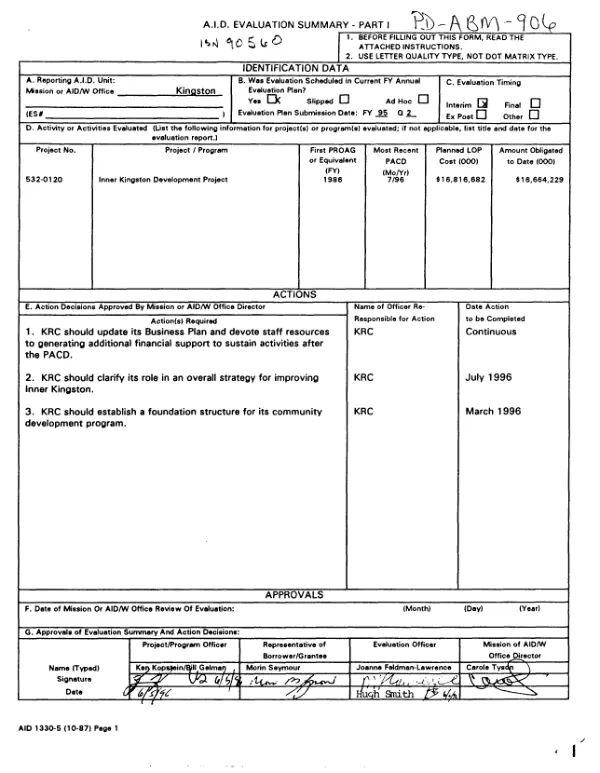
PACR of a project (1986-1996) to revitalize Inner Kingston, Jamaica, as a center of economic activity and job creation.
1996
Sign in to readA free account is required to download.
Abstract
The project has generated impressive results from a relatively small amount of USAID funds. Of particular importance was its role in helping to create an estimated 4,614 jobs, many of them for low income or unemployed residents of Inner Kingston. The Kingston Restoration Company (KRC), one of the implementing agencies, met or exceeded many of the targets set for it, producing 155% more space than projected under its Small Grants program and generating J$34 million in building improvements over a 4-year period. While KRC did not develop as much industrial space as planned, the goals were illustrative and its accomplishments were substantial. KRC"s results in terms of job generation and delivery of social services have equaled or exceeded expectations. The other implementing agency, The Urban Development Corporation (UDC), was not able to complete all planned infrastructure projects, and those that were completed were finished far behind schedule and far over budget. Still, new major infrastructure elements are in place today. There were also several unintended positive outcomes. First, KRC has developed a reputation and expertise which have made it a leader in shaping the revitalization process downtown. Starting with neither staff nor an office in 1986, KRC has become an important coordinator and initiator of public and private sector investment; is recognized for its political neutrality; is looked to by the Government of Jamaica (GOJ) for policy advice; and is regularly consulted on matters of policy and downtown problems by the GOJ, the Office of the Prime Minister, business and investment leaders, and international donor agencies. The GOJ has asked KRC to take responsibility for a number of difficult projects outside of Inner Kingston. Second, the GOJ has given downtown renewal priority attention in large part because of KRC activities. Third, the project has become a model program in terms of its comprehensive approach to urban problems and its impacts. Because of KRC"s effectiveness as a public-purpose private institution, it has received special attention from USAID and other international donors. The following lessons were learned. (1) Because urban renewal projects are complex and multi-faceted they require long-term commitment from funding sources and implementing agencies. Even in the United States a successful urban renewal program takes 20-30 years. The usual 5-10 year life of USAID projects could be taken into account to ensure that any interventions are strategically central to the longer term effort. (2) Urban renewal projects must simultaneously address both (a) physical revitalization of buildings and infrastructure and (b) community development to advance the human condition and income-earning potential of low-income area residents. (3) Sustainability of implementing agencies and the urban renewal program must be designed into the project by establishing long-term endowments and/or investing in assets that both achieve project purposes and yield long-term cash reflows. (4) Implementing agencies need to adopt a business planning process and produce annual business plans. (5) PVOs and NGOs operating social and economic development programs require significant long-term TA. (6) Government and the private sector need to create a development partnership and collaborative planning process that survive changes in government. (7) Small sub-grants as partial or matching funds and below-market interest rate loans are effective incentives to promote private sector investments. (8) Flexibility must be built into the design of complex urban renewal projects to account for normal cyclical changes to economic conditions that affect long-term private investment and to take advantage of opportunities that could not be anticipated at the design stage. (9) Patience in expecting visible urban renewal results needs to be built into project design and indicators as the urban development process builds momentum slowly. Unrealistic implementation schedules and targets cause unnecessary frustrations.
![Project assistance completion report [: inner Kingston employment]](https://covers.devme.ai/gen/9544.webp)