USAID DEC
Project assistance completion report : legislative assembly strengthening, project no. 519-0360
Sign inUSAID. MISSION TO EL SALVADOR
Project assistance completion report : legislative assembly strengthening, project no. 519-0360
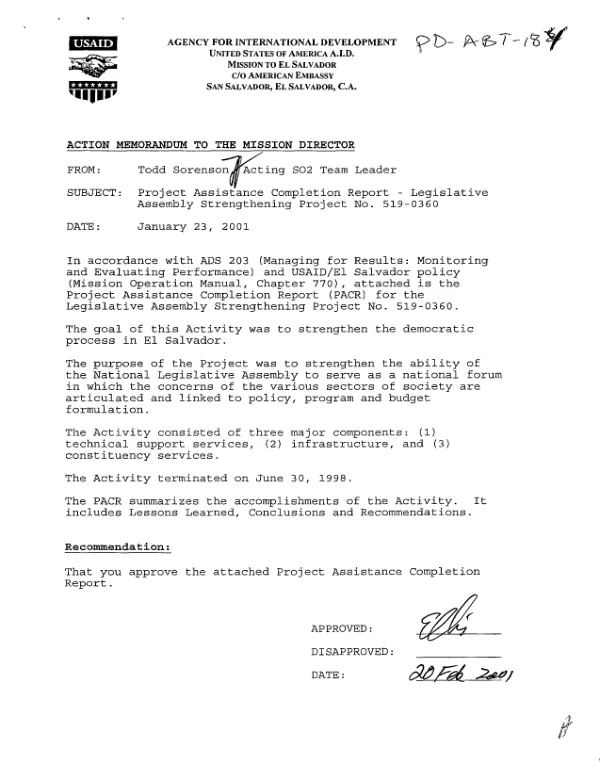
Final evaluation of a project (8/90-6/98) to enhance the operational effectiveness of the National Legislative Assembly (NLA) of El Salvador.
2001
Sign in to readA free account is required to download.
Abstract
The project met its intended goals, helping the NLA evolve from a rubber stamp congress to an independent deliberative body during a period of profound political change. Project seminars and workshops, opportunities to observe foreign legislatures in action, information resources, and additional professional staff have increased deputies' knowledge of their responsibilities and improved both the law and legislative process and the legislature's relationship with the executive and judicial branches. As a result, the NLA's deliberations have become more thoughtful and its relations with other branches of government more substantive. Infrastructure improvements, such as building additional offices, enabled many members to work more efficiently and meet with constituents for the first time. A project-inspired public awareness campaign sparked growing citizen interest in the NLA and increased contacts between citizens and their representatives. Lessons learned are as follows: (1) Legislative strengthening efforts must incorporate a country's political, social, and economic situation, and be flexible when circumstances arise that are neither predictable nor easily controlled. This project could not have been as successful as it was without the 1992 Peace Accords, which made it possible for all factions to participate in Salvadoran politics, and the subsequent 1994 elections, which seated representatives of all major political groups in the national legislature for the first time. (2) Initial and ongoing support from legislative leaders, political parties, and key staff is essential. In this project, a technical committee of deputies representing all major factions was critical to gaining acceptance from the NLA and ensuring the fullest and fairest possible use of project assistance. In contrast, the ambivalence of leaders from the country's dominant party toward the project was its biggest hurdle. (3) The project also supported other major areas, including infrastructure improvements and constituency services. Much of the project's success can be traced to its responsiveness to the priorities identified by the legislators themselves. (4) Project activities should promote ownership so that once USAID assistance ends, the legislature assumes responsibility for outcomes. (5) Project assistance should benefit as many legislators as possible. Providing office space, for example, enabled all deputies to carry out their legislative functions more efficiently and helped those parties participating for the first time feel like equal partners. (6) Legislatures that have functioned with or been dominated by one party will likely have undemocratic internal rules and operating procedures. Modernizing or reforming these vestiges of the past is critical, although the project's record on this score was mixed. The project was unable to overcome the resistance of the ruling party's members to internal rules reforms because they perceived the reforms as threats to their power. (7) An effective democratic legislature seeks and uses input from individuals and interests beyond the institution itself, such as civil society and the media. In El Salvador, these outside forces have traditionally played minor roles, giving the NLA little impetus to be more accountable and transparent. To build public confidence in the legislature as a democratic institution, groups representing all parts of the political spectrum should know how to initiate contacts with legislators. For their part, legislators should learn how to respond to and incorporate the input from this interaction into their decision-making processes. (8) The degree to which the legislature operates democratically serves as an example for similar developments in other areas. (9) Confronting beliefs that undermine an effective, democratic legislature is critical to the success of a legislative strengthening project. While the NLA has begun to appreciate new concepts such as constituent relations, Salvadoran political thinking does not yet fully embrace compiling complete and transparent records of proceedings as a useful tool for accomplishing legislative goals and building public confidence in the institution. Citizen participation in the legislative decisionmaking processes should be the focus of future assistance to the NLA.