USAID. MISSION TO DOMINICAN REPUBLIC
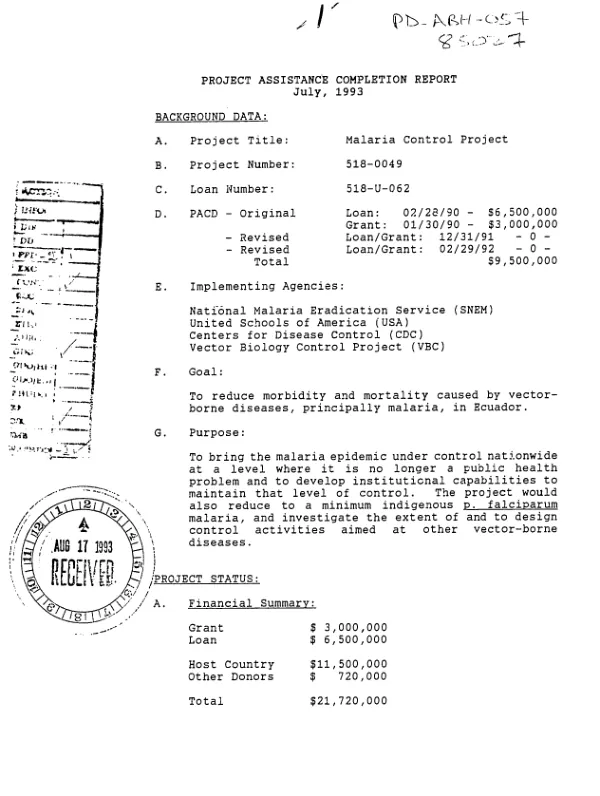
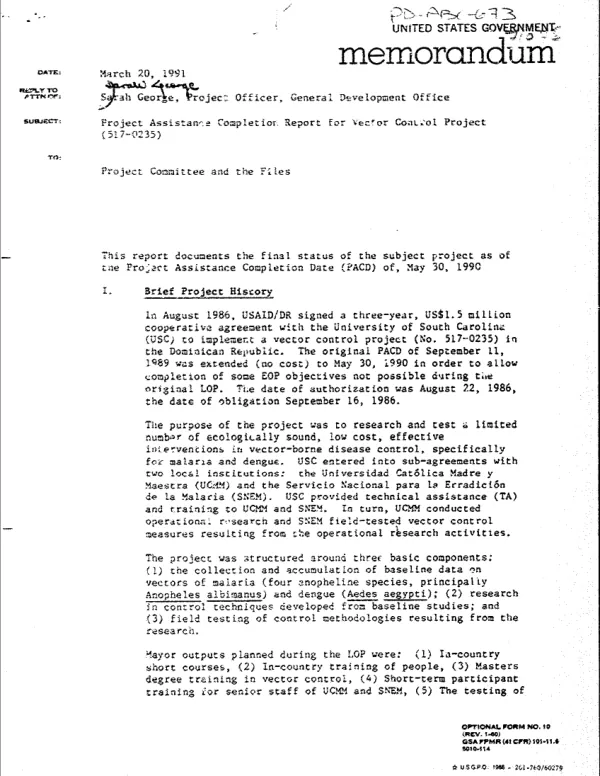
Project assistance completion report : malaria control project
PACR of a project (4/85-1/92) to strengthen Ecuador"s National Malaria Eradication and Vector Control Service (SNEM) and enable SNEM to control the current malaria epidemic.
1993
Sign in to readA free account is required to download.
Abstract
Results were mixed. A total of 1.27 million houses were sprayed, vs. 2 million targeted; 265 entomological tests were performed, vs. 338 targeted; 2 million presumptive drug treatments were given, vs. 2.2 million targeted; and 864,000 mass medications were accomplished, vs. 2.4 million targeted. By the end of the project, 67 laboratories were operational, vs. 70 targeted. The Ministry of Health strengthened SNEM by establishing a technical committee. The contractor, United Schools of America, failed to meet performance expectations and was continuously behind in payments to its consultants. This led to the resignation of the first long-term advisor, delaying project implementation. In-country training was provided to rural physicians, auxiliary nurses, and laboratory technicians in malaria control, prevention, diagnosis, and treatment. The Vector Biology Control Project provided training to sprayers. Two observational visits were funded. The Centers for Disease Control and the Vector Biology Control Project delivered satisfactory short-term TA and laboratory supply. The most important TA areas were information systems; assessment of the Aedes aegypti infestation; evaluation of vector control methods; a pilot study on integrating malaria control into general health services in Manabi province; analysis, evaluation, and training to improve spraying; logistics and supervision of field activities; administrative and logistics training; dengue control; and review of the Aedes/Dengue control program to improve program planning and to retrain national staff. Operations research related to computerization of information systems, stratified malaria control methodology, the sensitivity of P. falciparum to drugs, vector incrimination, and urban mosquito control. However, these research activities were delayed by continuous strikes by SNEM personnel. Any future initiative in malaria control in Ecuador must be preceded by an institutional analysis that examines SNEM, its role within the Ministry of Health, its strengths and weaknesses, and the presence (or absence) of political commitment to carry out fundamental institutional changes. The following lessons were learned. (1) Technical advisors should receive clear directions as to their responsibilities and authority. Counterparts must be fully aware of advisors" scope of work (2) Project extensions (cost or no-cost) should be analyzed in depth when counterpart administration has proven weak.