USAID. MISSION TO BOLIVIA
Project assistance completion report : market town capital formation (MTCF)
PACR of a project (7/86-1/94) to increase productive private sector investment in Bolivia's rural and semi-urban areas by decentralizing the investment financing system and through efforts in investment promotion and institution building.
1995
Sign in to readA free account is required to download.
Abstract
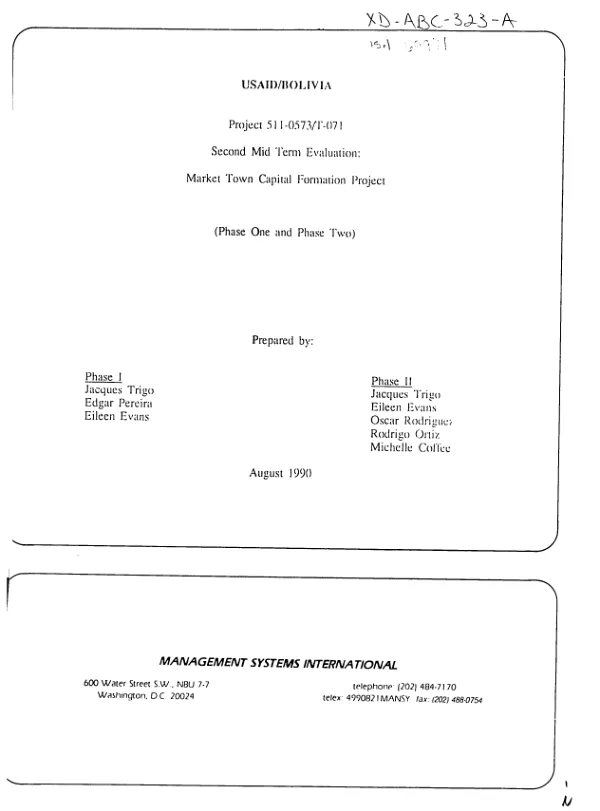
When it was found that only 2 of the targeted 5-10 market towns were actually benefitting from the project due to commercial bank reluctance to lend in these areas and to lack of adequate infrastructure, the project was expanded in 1989 to include major cities (La Paz, Cochabamba, and Santa Cruz), provided there were forward and backward linkages to rural areas. The investment finance mechanism, composed of financial credit units (FCUs), intermediate credit institutions (ICIs), and the Project Coordinating Unit (PCU), went through several phases; at one point, the Mission suspended project financing in order to develop a private financial institution, although it later dropped the idea at the urging of the FCUs and the Government of Bolivia. As of 1/94, the project had provided $31 million to finance 503 projects, mostly of small and medium size. Nonetheless, the financing mechanism has been unequal to the demand; several viable projects approved by the FCUs were not financed. The project achieved financial sustainability based on fees charged by the PCU and the FCU. All 8 FCUs had operating surpluses except Potosi and Oruro, two less developed regions which have insignificant support from the Departmental Development Corporations (DDCs) and which have been supported by the PCU. Regarding institution building, the capabilities of the PCU and the FCUs were improved, but not those of the ICIs. The system managed to mobilize the resources available despite uncertainties and bureaucratic delays, but did not achieve its objective of being fully decentralized. The objective to develop the FCUs as investment promotion entities was only partially met. Overall, despite the unwieldiness of the PCU/FCU/ICI system, the project succeeded in delivering loans in secondary areas where it would not have been possible before, and in stimulating private sector participation in the development process. Both socioeconomic and training objectives were attained. The project generated $56 million in exports and created 37,558 direct and indirect new jobs, most of them in the small and medium-scale export sector. In regard to training, various types of business training were provided to 816 male and 246 female participants, mostly Bolivian businesspeople. The objective of creating a permanent institutional structure was also achieved: Fundacion para la Produccion (FUNDA-PRO) has been legally created as a development finance entity. In regard to management, many of the contractor's activities were behind schedule, due in large part to an excessive focus on definitions and process rather than on the provision of TA or on actions leading to increased investment. Lessons learned from the two interim evaluations are included. See the abstracts of PD-AAZ-292 and PD-ABC-323.
Related documents