USAID DEC
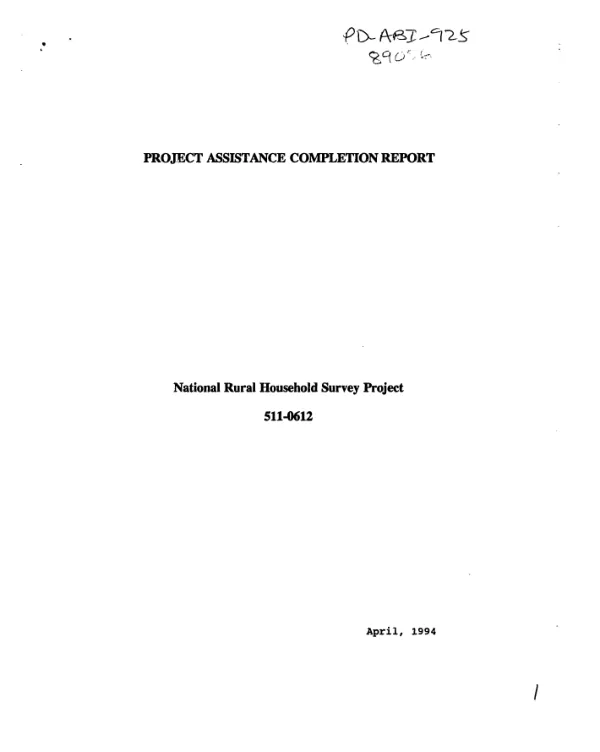
Project assistance completion report : national rural household survey project, 511-0612
Sign inUSAID. MISSION TO BOLIVIA
Project assistance completion report : national rural household survey project, 511-0612
PACR of a project (1990-9/93) to conduct a socioeconomic sample survey of rural Bolivia.
1994
Sign in to readA free account is required to download.
Abstract
The project was implemented by the Bolivian National Institute of Statistics (INE), with TA from the U.S. Bureau of the Census. INE's shortcomings, including technical and administrative inadequacies and a lack of commitment to the project (e.g., at the last minute A.I.D. had to provide INE with vehicles to conduct household interviews), caused the project to miss the 1-2 month period following harvest during which the national survey should have been conducted. It was therefore decided to conduct a smaller survey of the Department of Cochabamba. Using the Cochabamba data, a variety of analyses were carried out, including a multivariate analysis that defined a typology of rural households for assessing the impact of interventions, including interventions aimed at raising household incomes through non-coca related activities. Planned analyses of labor use by gender, non-farm activities, and market access and farm incomes were not completed, however. The project has been criticized for its high apparent costs -- $990 for each of the 1,344 households sampled -- but many expenditures were for applications useful beyond this particular survey; for example $500,000 was spent on a comprehensive cartographic survey which facilitated Bolivia's 1992 Census. Targets for developing survey procedural manuals, training professionals, and publishing survey results were met or almost met. Planned publicity campaigns were not done because of the great political sensitivity of questions regarding coca production. Despite its small size, the Cochabamba survey produced high quality results which were used by the Government of Bolivia (GOB) to analyze labor organization in rural households, examine food security, and engage in preliminary rural development planning; and by the Cochabamba Regional Development project to design a complementary agricultural area survey in Chapare where non-coca crops are being introduced. The GOB also used the results of the survey to produce a comprehensive and well thought out proposal for going forward with the national survey at the end of the 1994 agricultural season. However, given USAID/B's resources and objectives, and the INE's technical and administrative shortcomings, USAID/B decided not to assist this survey through the present project, which was then terminated 9/30/93, consistent with the PACD. The following lessons were learned. (1) Due to its ad hoc nature, the institutional analysis conducted during project design overestimated INE's institutional capacities, requiring USAID/B to play a larger management role than it had anticipated. (2) A full-time project manager/coordinator of statistical and survey methods and analyses should have been contracted before the survey was initiated to collaborate with INE personnel and look after A.I.D. interests throughout the project. Temporary PASA experts undoubtedly shared valuable expertise, but one full-time coordinator would have prevented problems resulting from long-distance coordination. (3) Except for the Department of Cochabamba, the problem of paucity of household data has not been resolved and poses a serious problem in designing sustainable development activities in rural areas.
Related documents
![CARDI [Caribbean Agricultural Research and Development Institute]/UWI [University of West Indies] agricultural research and extension project : AID grant no. 538-0164 -- final evaluation report](https://covers.devme.ai/gen/7430.webp)