USAID DEC
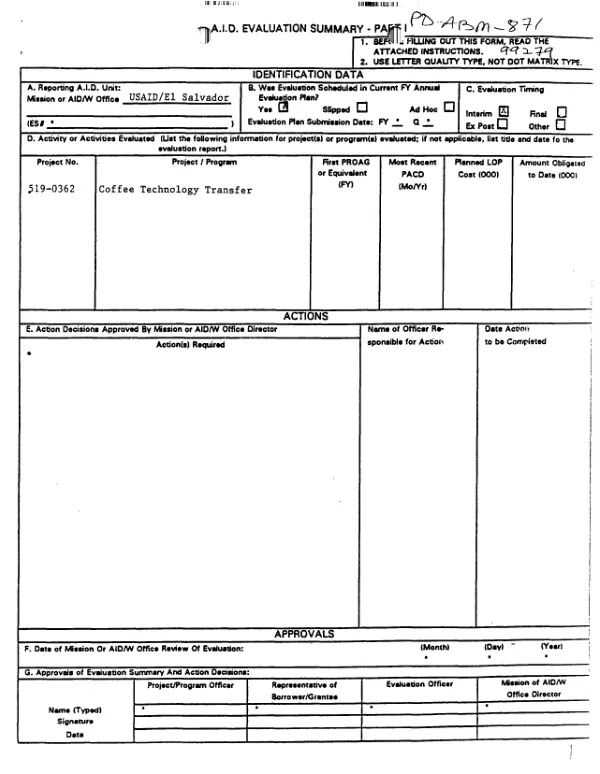
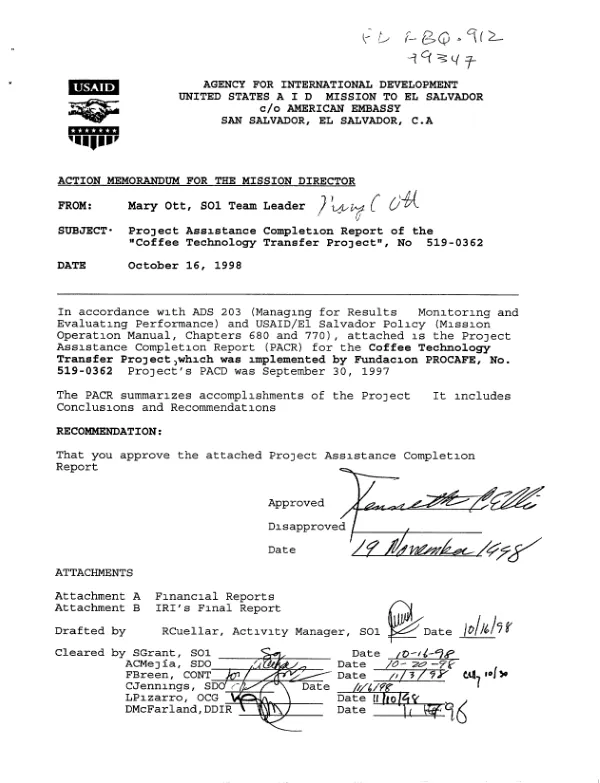
Project assistance completion report of the 'coffee technology transfer project' no. 519-0362
Sign inUSAID. MISSION TO EL SALVADOR
Project assistance completion report of the 'coffee technology transfer project' no. 519-0362
PACR of a project (7/92-9/97) to increase coffee production in El Salvador, especially among smallholders.
1998
Sign in to readA free account is required to download.
Abstract
The project was implemented by the Salvadoran Coffee Research Foundation (PROCAFE), with TA from the International Research Institute (IRI). The project did not fit very well under the Mission's 6/96 Strategic Objective No. 1 Technology/Marketing Results Package, which called for strengthening secondary level organizations, forming cooperatives and producer groups, and affiliating small farmers to primary and secondary level organizations. PROCAFE stated in writing that promoting affiliation or forming cooperatives was not their mandate. As a result, when USAID/W reduced the Mission's FY 1997 budget by $2 million, the PROCAFE project was one of those selected to "pay the bill". This resulted in a large-scale suspension of activities with PROCAFE during 1996 and the first semester of 1997. Overall conclusions are as follows: (1) PROCAFE's medium-term financial position is relatively strong. However, the lack of assured long-term counterpart funding is a dark cloud over PROCAFE's future. PROCAFE management should make a concerted effort with coffee sector leaders to resolve this uncertainty. (2) PROCAFE has made good progress toward becoming a capable coffee research and extension organization, though the slow delivery of vehicles and computers has had a negative effect on PROCAFE's performance, especially in extension activities. TA provided by IRI, though costly, has given USAID good value for its money. (3) Privatization of coffee research has had several positive effects. On the negative side, PROCAFE's research program does not differentiate between high- and low-resource technologies, and the complexity and importance of the environmental aspects of the coffee industry are not reflected in its research program. There is also a need to integrate more economic criteria into the research program and to monitor the sectoral impact of adopted technologies. (4) Those receiving TA from PROCAFE regard it highly, but often indicate the need for more. (5) The inability of small producers and agrarian reform cooperatives to obtain access to credit is a serious limitation to the adoption of PROCAFE's recommendations.
Related documents