USAID DEC
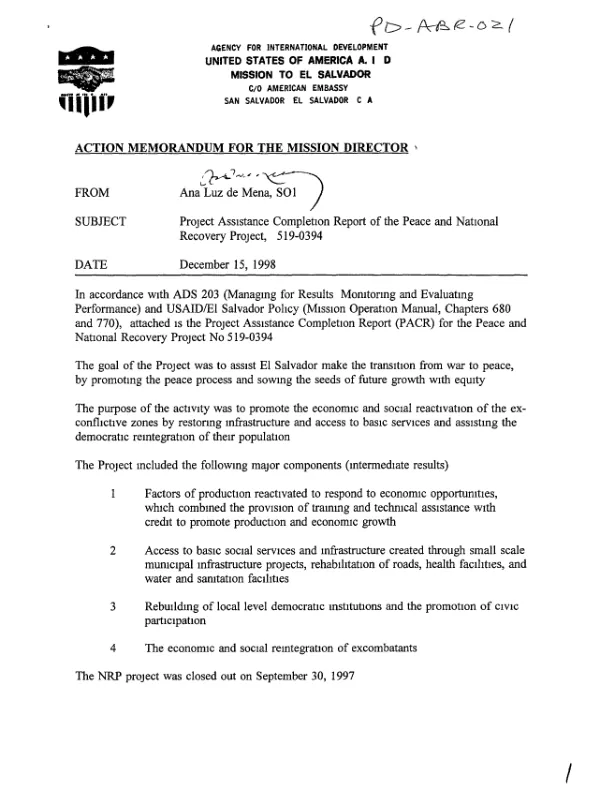
Project assistance completion report of the peace and national recovery project, 519-0394
Sign inUSAID. MISSION TO EL SALVADOR
Project assistance completion report of the peace and national recovery project, 519-0394
PACR of a project (1/92-9/97) to promote the economic and social reactivation of ex-conflictive zones in El Salvador by restoring infrastructure and access to basic services and by assisting the democratic reintegration of their populations.
1998
Sign in to readA free account is required to download.
Abstract
The project had a significant part in ensuring timely completion of the Peace Accords and set the foundation for the Mission's present efforts to reduce rural poverty and promote more broadly based economic growth. During the life of this project, the largest program in recent history to transfer land to excombatants of a civil war was fully completed. Following the signing of the Accords, the Mission helped promote democratic elections with broad citizen participation. A major investment was made to replace and repair destroyed or abandoned infrastructure. Local government, seriously debilitated during the war, was strengthened, and civilian participation in local government increased. Accomplishments in the four project areas are noted below. Over 107,000 individuals -- ex-combatants and civilians alike -- received training or TA in agriculture and small business development, and nearly 93,900 loans were provided to increase crop production and establish or expand microenterprises. According to recent surveys, a large majority of National Reconstruction Plan (NRP) beneficiaries, amounting to almost three quarters of the credit activity's target population, averaged a 33% income increase over a 2-year period. Household income has risen most dramatically in the eastern department of La Union and in the former conflictive zones of Chalatenango, Cabanas, San Vicente, and Usulutan. By 9/97, 36,059 eligible beneficiaries had received land with the help of project financial or administrative assistance. The project also played a central role in securing the full cancellation of the land transfer program debt, and in ensuring that program beneficiaries held their land free and clear of all debt. A total of 1.1 million people living in the NRP zone benefitted from more than 2,900 small-scale infrastructure activities, including municipal facilities such as schools and health clinics, water systems, and rural electrification. Three hundred km of rural electric lines were installed, benefitting some 3,400 families in isolated towns and villages; 2,160 km of rural roads were also rehabilitated, accounting for 24% of the roads needing rehabilitation in the NRP area. Over the life of the project, the NRP channeled nearly $100 million in resources through 137 NGOs to support a wide array of ex-combatant and civilian development activities. The use of NGOs greatly facilitated the implementation of the NRP, and was essential in providing access to program services by the target population, a large percentage of which is located in remote, war-torn areas. Assistance to NGOs also strengthened their rural organizational base, improving their advocacy capacity on behalf of rural populations. The project also contributed significantly to building participatory democracy by supporting 1,378 municipal open town meetings, with over 175,000 Salvadorans participating. The project helped reintegrate ex-combatants into mainstream society by providing vocational and academic training to more than 21,000 ex-combatants, 17,000 of whom received agricultural and microenterprise credit; more than 9,000 war-wounded received rehabilitation services; and 36,059 ex-combatants and tenedores received land under the land transfer program. The peace is an integral part of Salvadoran society. The National Liberation Front (FMLN) is now a powerful political party, sharing control of the legislature with the ARENA party, and controlling, in the political sense, the largest municipalities in the country. Ex-combatants from both sides struggle to advance economically along with a broad segment of Salvadoran society. Although violence is widespread, organized military conflict is a thing of the past. In the ex-conflictive zones, as well as in the broader society, potable water, rural roads, electricity, and health and educational services are still in short supply, but exist in far greater abundance than during the war years. The culmination of the Peace Accords has ratified for the broad reaches of Salvadoran society the desirability of open political and economic structures as the surest road to long-term economic and political development.
Related documents
Documents in this collection
 1996
1996USAID DEC
Assistance to the transition from war to peace : evaluation of USAID/El Salvador"s special strategic objective (project no. 519-0394)
Open record 1996
1996USAID DEC