USAID. BUR. FOR LATIN AMERICA AND THE CARIBBEAN
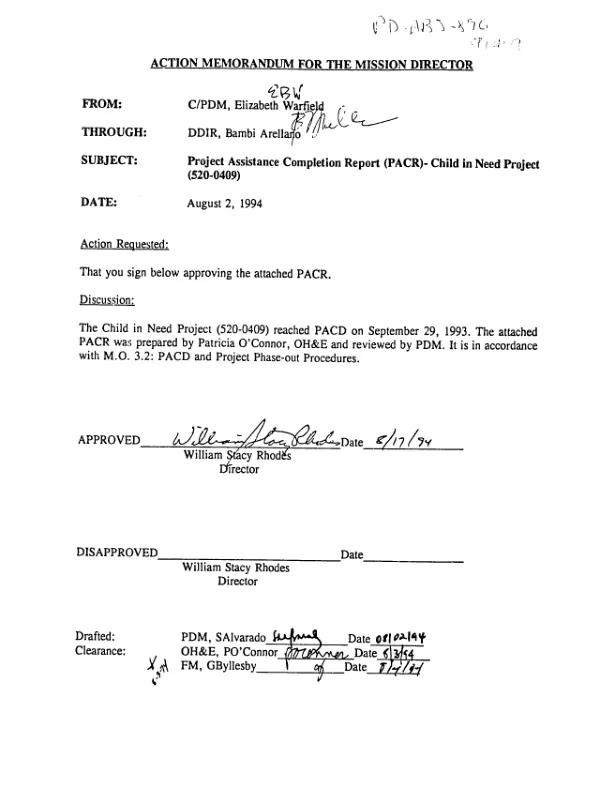
Project assistance completion report (PACR) : child in need project (520-0409)
PACR of a grant (9/91-9/93) to World Share to improve social services for street children and orphans in Guatemala.
O'Connor, Patricia · 1994
Sign in to readA free account is required to download.
Abstract
World Share made subgrants to eleven small local NGOs to provide child feeding programs, primary health care, clothing, shelter (especially small group homes), formal and nonformal education, and counseling for some 1,200 children. Due to financial management problems identified during a 7/92 mid-project evaluation, the grant to World Share was limited to the amount already obligated ($368,000 vs. a planned $475,000) and no further subgrants were made. Although the mid-term evaluation also found that the project was too geographically diffuse to have a demonstrable impact, and, most particularly, that insufficient efforts were made by NGOs to provide de-institutionalized and community-based services, the project's final evaluation concluded that the project was largely successful. The evaluation concluded that all subgrantees had benefited from the project; abetted by training and TA from World Share, some had strengthened their administrative capacity and several had improved their infrastructure, thereby enhancing their capabilities to care for disadvantaged children. Ten of the eleven subgrants increased the beneficiaries' level of formal primary education. Two of the most important educational interventions provided the children with sex education and an awareness of their legal rights. Many subgrant activities were income-generating efforts such as vegetable gardening or clothing microenterprises. Additionally, most of the subgrantees had community-level impacts, e.g., by offering training or microenterprise opportunities to single mothers, adolescents, or other community members. The sheer numbers of street, working, and abused children exceeded the service capacity of the NGOs. The key lesson learned is that such projects require a limited programmatic and geographic focus. Realizing this, the Mission incorporated findings from this project into the design of the new Street Children Support project, which focuses much more closely on children living or working on the street and on abused children, particularly in Guatemala City. Other lessons learned are as follows. (1) Guatemalan NGOs involved in service delivery to street and working children have limited exposure to innovative models developed in other settings. In addition, they often have limited financial and management capabilities and need strengthening in these areas. (2) Insufficient understanding of the nature and scope of the problems of street and working children in Guatemala limits the capacity of both NGOs and international donors to respond adequately to the problem.