USAID DEC
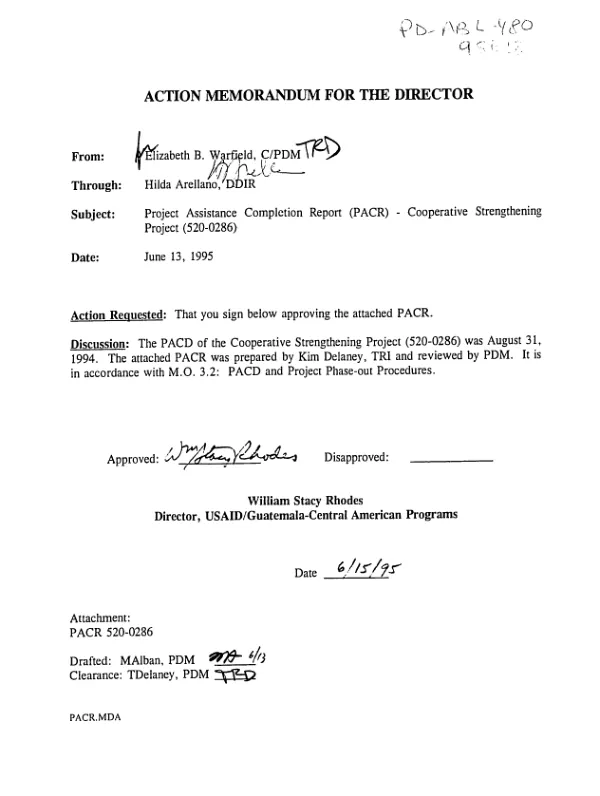
Project assistance completion report (PACR) : cooperative strengthening project (520-0286)
Sign inUSAID. MISSION TO GUATEMALA
Project assistance completion report (PACR) : cooperative strengthening project (520-0286)
PACR of a project (7/86-8/94) to strengthen the service delivery and management capability of Guatemalan cooperatives.
1995
Sign in to readA free account is required to download.
Abstract
The project was implemented by the National Federation of Savings and Loan Cooperatives (FENACOAC) and the World Council of Credit Unions (WOCCU). By any measure, the project was a success. It either met or exceeded each of its targets, leaving behind a network of financially viable and well-managed credit unions and agricultural cooperatives. Four federations -- FENACOAC, the Coffee Federation of Alta Verapaz (FEDECOVERA), the Artisans Cooperative Federation (ARTEXCO), and the Federation of Agricultural Cooperatives (FEDECOAG) -- along with 34 primary cooperatives established policies and membership bases, and obtained the capital needed for long-term viability. A particular beneficiary of the project was the national credit union movement, represented by FENACOAC and its affiliates. The Federation is now one of the strongest in Latin America. Credit unions have eliminated their dependence on external capital, are mobilizing significant local savings, lending on the basis of ability to repay, controlling delinquency, and planning for the future. Credit unions now provide a wide array of competitively priced financial services to rural communities. Non-credit union organizations have obtained similar but less dramatic results; although smaller in total membership and slower to develop, they have adopted an entrepreneurial approach to member services, greatly improved their financial condition, and improved their ability to provide effective and competitively priced services to their members. Business volume has increased and capital is growing. To ensure the sustainability of project efforts, more than $4 million in income generated from the original stabilization fund and the interest earned thereon has been allocated to FENACOAC (to fund 3 years of follow-on TA from WOCCU), to ARTEXCO (for the purchase of a commercial dye facility), and to the agricultural credit funds of FEDECOVERA, FEDECOAG, Renacimiento 59 Coffee Cooperative, and the Jalapa Coffee Cooperative Association. The project"s success is attributed to: (1) clearly defined objectives, policies, and operating principles; (2) the direct daily involvement of the A.I.D. project manager, which facilitated coordination with the Mission and compliance with project norms and procedures; (3) excellent project direction by a person with the interpersonal skills, discipline, and technical knowledge to make difficult decisions and work with a wide range of project staff; (4) the use of pilot programs to introduce new concepts aimed at winning acceptance of new techniques; (5) the establishment of monitoring and control systems that allowed project staff to rapidly respond to problems in implementing organizations; (6) consistent application of project norms to all organizations involved in the project, creating greater discipline among project beneficiaries; and (7) successful development of a fee-for-services mentality among project staff and implementing institutions to break prior dependence on free donor resources. The following lessons were learned. (1) The original project design was too expansive for the funds and technical capacity that were available. (2) Relationships with project beneficiaries and implementing organizations should be as direct as possible to avoid delays in implementation. Originally, the project provided all assistance through cooperative federations, which created bureaucratic problems and delays. (3) Before a project expansion is approved, future funding should be relatively secure. In this project, the inclusion of agricultural export organizations in 1990 resulted in the expenditure of much time and resources that could have been better spent on other activities, especially since these organizations were later excluded from the project due to budget cuts. (4) Low salary levels in the cooperatives led to rotation of personnel and the training of many cooperative staff who have now left the cooperative system. To avoid a waste of training opportunities, the project should have tried to address the issue of staff rotation.