USAID DEC
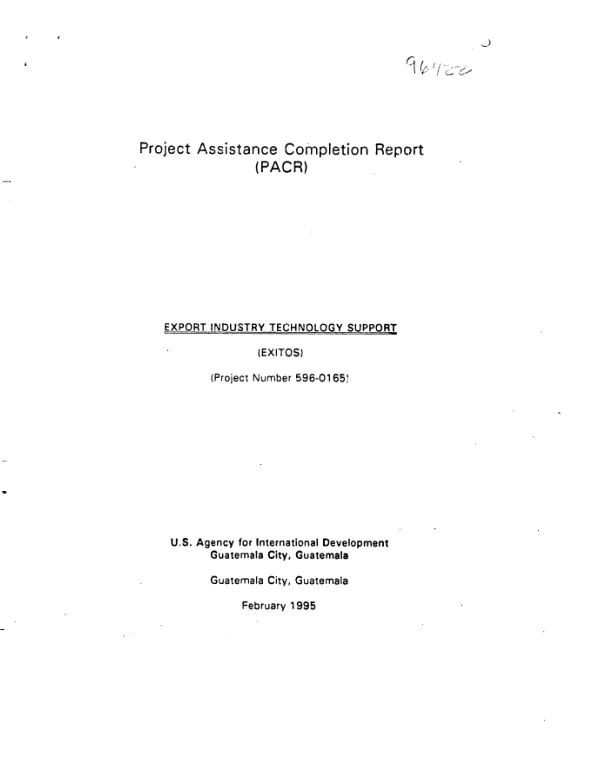
Project assistance completion report (PACR) : export industry technology support (EXITOS)
Sign inUSAID. BUR. FOR LATIN AMERICA AND THE CARIBBEAN. REGIONAL OFC. FOR CENTRAL AMERICAN PROGRAMS (ROCAP)
Project assistance completion report (PACR) : export industry technology support (EXITOS)
PACR of a project (10/91-2/95) to increase Central American non-traditional agricultural exports (NTAEs) (EXITOS project).
1995
Sign in to readA free account is required to download.
Abstract
The Exitos project, an extension of the Non-Traditional Agricultural Support Project (PROEXAG), continued that project's focus on facilitating and supporting produce "deals" (which combine production area, crop, product form, seasonality, and target market) by providing export entrepreneurs with "know-how" -- data, technology, and competitive intelligence, along with the skills needed to use these tools effectively in the pursuit of profitable opportunities. Major results of the project include the following. (1) New country/crop combinations were established in every country of Central America, thereby diversifying the economy and providing increased job opportunities, better economic stability, more foreign exchange, and, tangentially, greater political stability. (2) The project encouraged the production of produce counter-seasonally to production in the United States, thereby complementing the supply of fresh produce and making more items available year around to the U.S. consumer. (3) Each dollar of U.S. taxpayer money spent on PROEXAG and EXITOS had a return of $8.82 to the economies of Central America, and $13.08 to the economy of the United States. (4) Over 10,000 farms received some sort of assistance from the projects, with over 8,000 of those farms being of one ha or less in size. (5) Farms and businesses in Central America receiving project assistance employed over 80,000 individuals. A preponderance of those jobs were in rural areas, and a majority went to women. (6) Over 5,300 permanent jobs were created in the United States by the economic activity directly attributable to the projects. No U.S. jobs were lost to Central America due to project activity. Lessons learned are largely the same as those from PROEXAG. (1) Growth in the NTAE subsector depends above all on the establishment of viable NTAE-oriented businesses. (2) NTAE businesses are high-risk ventures because they usually involve new crops that are subject to unpredictable weather and pest/disease problems and involve highly perishable crops, allow little margin for error and correction and usually require carrying key personnel through the off-season, tend to aim for short market windows that shift each season and disappear with time, and are prone to sudden and marked price changes. (3) Each combination of crop, product form, and end-market is a different business.
Related documents