USAID DEC
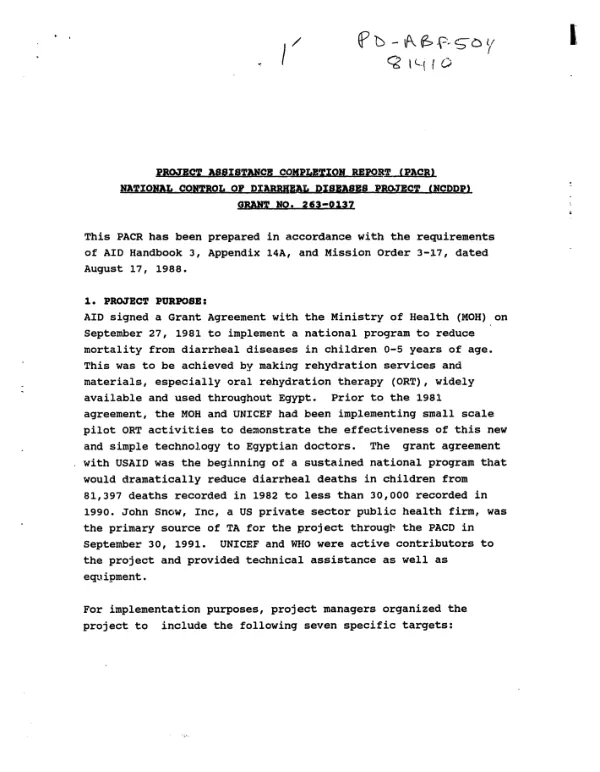
Project assistance completion report (PACR) : national control of diarrheal diseases project (NCDDP), grant no. 263-0137
Sign inUSAID. MISSION TO EGYPT
Project assistance completion report (PACR) : national control of diarrheal diseases project (NCDDP), grant no. 263-0137
PACR of a project (9/81-9/91) to reduce mortality due to diarrheal diseases among Egyptian children aged 0-5 years, mainly through the extension of oral rehydration therapy (ORT).
1992
Sign in to readA free account is required to download.
Abstract
Exceeding all targets, the project dramatically reduced child mortality due to diarrhea (from 33/1,000 in 1982 to 11.8/1,000 in 1991, a 64.5% decline) and has earned a worldwide reputation for its success. Specifically, the project: (1) increased mothers" awareness of ORT to 99% since 1985 vs. a targeted 90%; (2) raised mothers" knowledge of proper mixing of oral rehydration salts (ORS) to 90% vs. a targeted 75%; and (3) raised mother"s use of ORS to treat diarrhea to at least 66% vs. a targeted 50%. The training program was highly successful. A total of 47 appropriately equipped governorate training centers offered hands-on ORT training to over 10,000 physicians and 15,000 nurses, while workshops for medical organizations -- the Pediatric Society, the Pharmacists Syndicate, and the Friends of Breast milk Society -- provided information on ORT to administrators, pharmacists, statisticians, social workers, and community leaders. The project also helped add ORT to medical and nursing school curricula. Mass media -- primarily TV, accessible to 90% of the Egyptian population -- were used to introduce ORT to the public, resulting in increased awareness of and demand for ORT. In response, USAID, in collaboration with UNICEF, worked with the MOH to ensure uninterrupted production of ORS (initially, UNICEF provided equipment and raw materials and USAID financed production). The government pharmaceutical firm responsible for ORS production originally did so under a MOH administrative order, not because the activity was profitable. Toward the end of the project, ORS prices were increased to ensure continued production. Project sustainability has been encouraged through the government"s creation of a budgetary line item for ORT and through establishment of a directorate-level MOH administrative unit. Nonetheless, sustainability is doubtful (some efforts have been relaxed already since the 9/91 PACD) unless creative financing measures can be utilized. Also needed is policy dialogue on the turf battle within the MOH concerning the use of funds from the Child Survival project (2630203) to monitor diarrhea incidence (which has changed little over the life of the project). Research by UNICEF demonstrates that diarrhea can be prevented at the village level through the use of low-cost technology in sanitation, water supply, and community health education. In this context, USAID needs to examine why its water and sanitation projects, costing millions of dollars, seem to have made no impact at all on diarrhea incidence. Project research also discovered that rice-based ORS has definite advantages over the regular glucose-based formula and that there are a small percentage of diarrhea cases that are not responsive to ORT. More work is needed in these areas, and also in (1) discouraging inappropriate use of drugs (especially antibiotics) in treating diarrhea, and (2) overcoming continuing problems in mothers" incorrect ORS mixing/dosing. Several lessons were learned. (1) The project was successful due to a unique set of physical and economic conditions within Egypt -- good leadership, plentiful resources, a culturally homogenous society, a settlement pattern which enhanced the use of media and project management, and an elaborate MOH infrastructure. These conditions may not be easily replicable elsewhere. (2) Vertically structured, semiautonomous interventions can be highly effective but are difficult to integrate into the health service system when external funding ceases. (3) Pilot testing is important for programs intended for nationwide implementation. (4) Mass media are a successful, cost-effective means of increasing demand for child health services. (5) The use of one contractor throughout a project contributes to smooth implementation and results in the trust of local experts and authorities.
![Report of the child survival X project [Ecuador] : final evaluation](https://covers.devme.ai/gen/53377.webp)
![[Development Fund for Africa --] impact of child survival activities in Africa : a report on AID's progress in reducing infant and child mortality and illness in 17 child survival priority countries](https://covers.devme.ai/gen/8905.webp)