USAID DEC
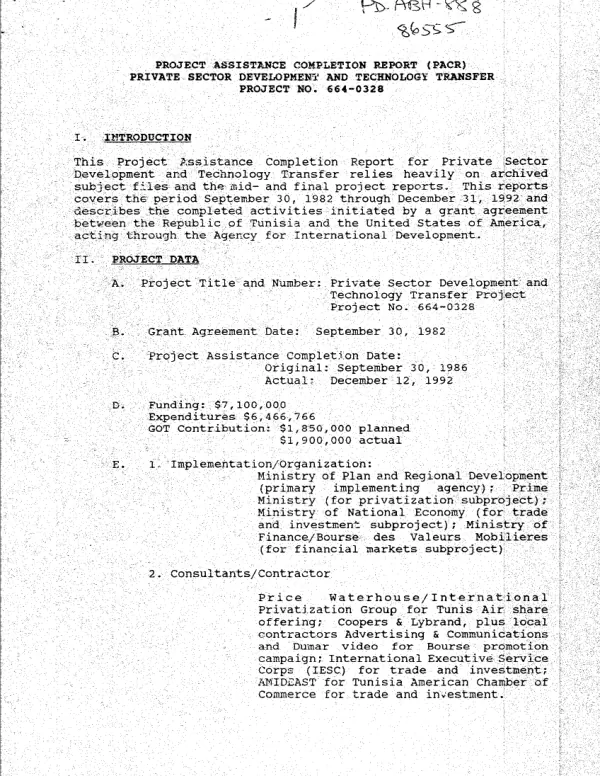
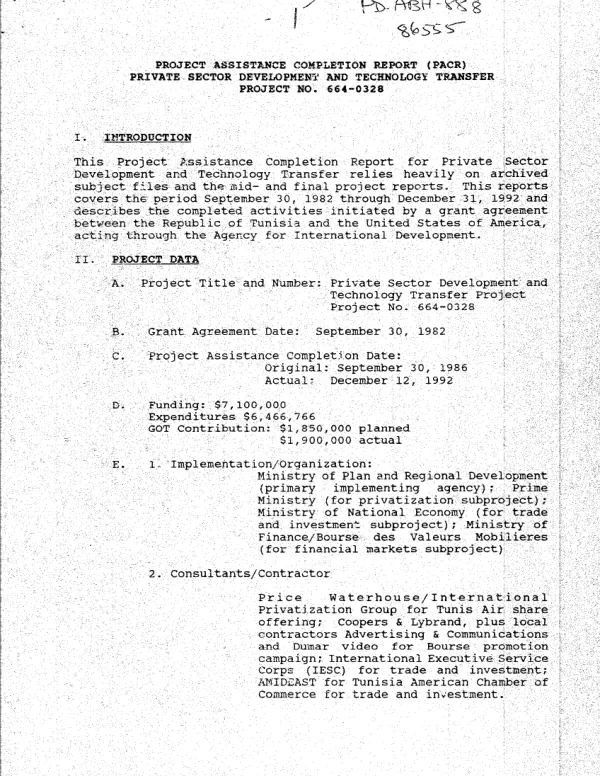
Project assistance completion report (PACR) : private sector development and technology transfer, project no. 664-0328
Sign inUSAID. MISSION TO TUNISIA
Project assistance completion report (PACR) : private sector development and technology transfer, project no. 664-0328
PACR of a project (9/82-12/92) to promote the role of the private sector in Tunisia's economy and increase the rate of return on completed or nearly completed A.I.D.
Sign in to readA free account is required to download.
Abstract
projects. During its first phase (1982-88), the project undertook a number of small, demand-driven interventions (e.g., seminars, studies, trips abroad, short-term training and TA) that were not very focused or coherent, and which imposed a high administrative burden. In 1988 the project was redesigned to focus on three issues: privatization, capital markets development, and trade liberalization. Overall, the project achieved its objectives. Training has increased the capacity of Government of Tunisia (GOT) personnel to conduct policy analysis and draft action plans, and policy dialogue with the GOT on privatization has helped in the implementation of liberalization policies. Some of the changes that have taken place over the project's life have been striking. Exports have been virtually freed from licensing, and several initiatives have been undertaken to encourage exports; price controls have become less extensive; state-owned enterprises are being sold (albeit not at the rate or of the type anticipated); investment approval procedures have been centralized and streamlined; tax laws on expatriates have been modified; the Stock Exchange is viable, even though it is smaller than had been hoped. The Tunisian-American Chamber of Commerce is serving the business community; U.S. businesses -- mostly recently, Sara Lee -- are seeing the value of doing business in Tunisia; and the environment for foreign investment has improved. With these developments towards a market economy, Tunisia is ready for even more changes. The project yielded a fine harvest of lessons learned. (1) When commitment to a relatively new concept such as private sector development is weak, a target of opportunity approach makes sense -- but has high administrative costs. (2) Activities implemented directly with or through the private sector tend to advance more rapidly than those involving public organizations. (3) Use of multiple implementing mechanisms reduces the risks associated with employing a single contractor, but greatly increases administrative complexity. (4) Lack of publicity can facilitate initial privatization transactions, but in the long run harms the program by increasing the suspicions of labor, the private sector, and the general public about the government's motives. (5) Given the reluctance of most privately owned businesses to open their capital to outsiders, the government can be a prime force in developing financial markets by widely distributing public share offerings of state-owned firms. (6) Tunisia views European technology as having originated in the United States and therefore finds efforts to increase direct access to U.S. technology attractive. (7) USAID regulations effectively preclude the possibility of a direct grant to a newly formed local organization, complicating the task of creating such organizations. (8) It is difficult to reconcile the interests of local and U.S. members of a Tunisian-American business organization; the former focus on identifying new markets and sources of inputs in the United State, the latter on problems with local administration.