USAID DEC
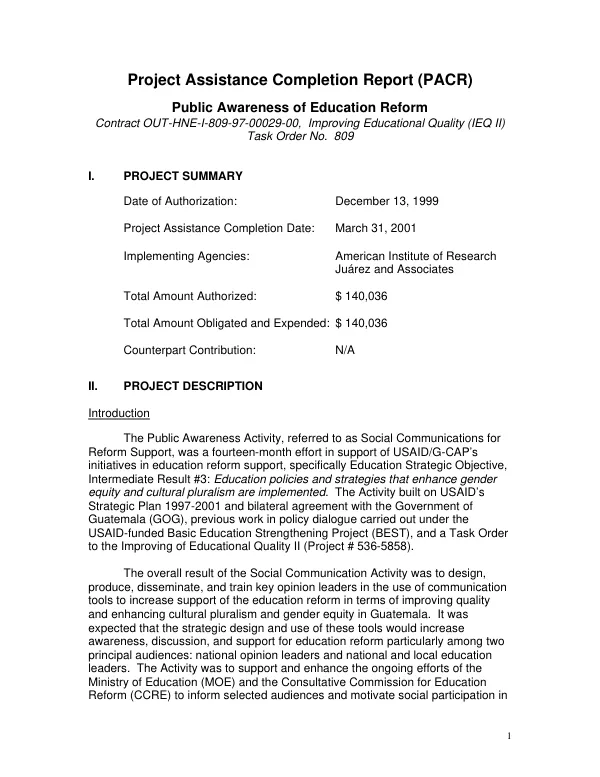
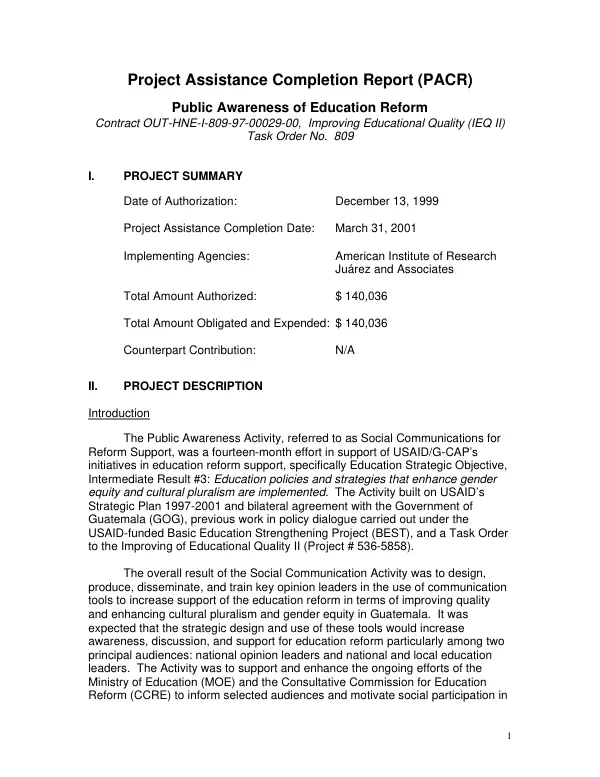
Project assistance completion report (PACR) : public awareness of education reform -- contract OUT-HNE-I-809-97-00029-00, improving educational quality (IEQ II) : task order no. 809
Sign inUSAID. MISSION TO GUATEMALA. CENTRAL AMERICAN PROGRAMS
Project assistance completion report (PACR) : public awareness of education reform -- contract OUT-HNE-I-809-97-00029-00, improving educational quality (IEQ II) : task order no. 809
PACR of a project (12/99-2/01) to increase public awareness of the need for education reform in Guatemala.
Sign in to readA free account is required to download.
Abstract
The project's greatest accomplishment and contribution was the production and dissemination of a CD-ROM with the PowerPoint presentation titled: "Educacion por Todos: Llegaremos a Donde Queremos Llegar?" This presentation updates and expands a PowerPoint presentation titled, "Aprendiendo, Desarrollamos Nuestra Guatemala" originally produced in diskettes and overheads under the Policy Dialogue component of the Mission's Basic Education Strengthening (BEST) project in 1997. The CD-ROM contains several prefabricated presentations, varying in length and designed for specific audiences such as educators, researchers, NGO leaders, press corps, elected officials in the executive and legislative branches of government, or private sector leaders. Each presentation is programmed with automation effects and speakers' notes. Dissemination of the CD was broad and included national, international, public, private, and NGO leaders. Tangible, immediate contributions of the communication tool include several examples of increased awareness, discussion, and support for education reform: effective use by commercial leaders to persuade the National Advertising Council to focus a national 20-year campaign on education as the number one priority in Guatemala; use by the leading civil society organization (CSO) alliance (Gran Campana por la Educacion) to lobby for increased financing for education sector; use of data by education leaders, the Government of Guatemala/Ministry of Education (GOG/MOE), and CSOs resulting in increased press coverage; use by the USAID/Management Systems International (MSI) policy reform support activity in training sessions on policy and stakeholder analysis among selected CSOs. A second project contribution is the audience assessment, key findings were disseminated to partners, including the MOE and the Consultitave Commission for Educational Reform (CCRE) via formal presentations, and the executive summary of the final report was forwarded to all respondents. These findings are as follows: (1) Consensus among interviewees that the current state of education is poor and that the sector requires "investment" in order to improve. (2) A general perception that reform of the education system is urgently needed, but there is not consensus on the Parity Commission's Education Reform Design on the "how-to". (3) The public needs information on what education reform actually is and how it relates to citizens' daily lives before attitudes about it will improve (participants emphasized the need for information dissemination, dialogue, and consensus before society at large will endorse reform and participate. (4) Informational material should be mostly visual, be distributed locally, use testimonials as a medium, and be culturally appropriate. (5) The CCRE is believed capable of leading a communications strategy directed at decisionmakers and is well-suited because it is at the margins of political interests. (6) More information is needed as to what intercultural education is and how it works. (7) Achieving gender equity is believed to be important, though more conservative respondents considered it less important than other aspects of reform. Includes lessons learned regarding project replicability and sustainability and the design and implementation of new activities. (Author abstract, modified)
Related documents
Documents in this collection
 1970
1970USAID DEC
Project assistance completion report (PACR) : public awareness of education reform -- contract OUT-HNE-I-809-97-00029-00, improving educational quality (IEQ II) : task order no. 809
Open record 2002
2002USAID DEC
![Final evaluation report : HIV/AIDS prevention in Africa program [HAPA], Marondera District, Zimbabwe](https://covers.devme.ai/gen/6243.webp)