USAID DEC
Project assistance completion report (PACR) : rural community health project no. 664-0296
Sign inUSAID. MISSION TO TUNISIA
Project assistance completion report (PACR) : rural community health project no. 664-0296
Presents final Mission report on a project (9/77-6/87) to implement a new system of primary health care (PHC) in Central Tunisia in an expanded network of facilities.
1991
Sign in to readA free account is required to download.
Abstract
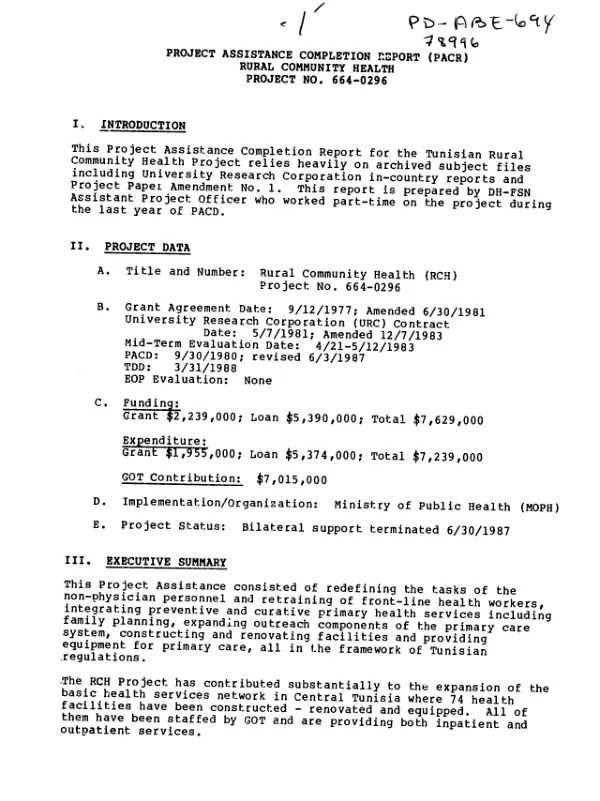
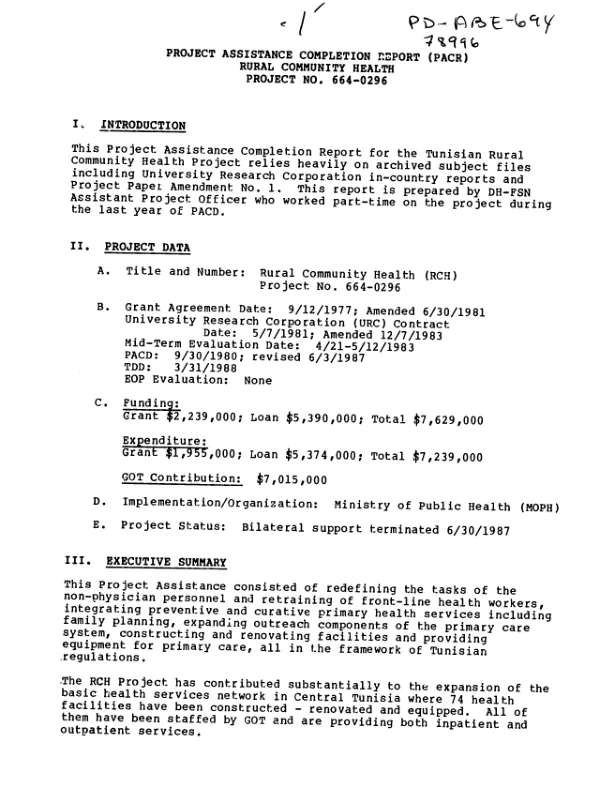
The project substantively strengthened the provision of PHC in Central Tunisia. A total of 74 PHC facilities were constructed/renovated and equipped -- including 22 new centers in Siliana and Sidi Bouzid; 36 new centers in Kasserine and Gafsa; 9 renovations in Siliana, Sidi Bouzid, and Sned; and 7 renovations in Kasserine and North Gafsa. The project also restructured the role of paraprofessional health workers while simultaneously establishing a field practice setting in which medical students and interns are trained in community medicine. Paraprofessionals were (re)trained, with a focus on preventive care, and now provide more systematic service delivery. Seven long-term U.S. trainees have returned to ministerial positions where they have an impact on PHC delivery. The project also made special efforts to strengthen health education capacities and provide continuing education. The project succeeded in integrating preventive and curative PHC (including family planning) and in expanding community level outreach. The involvement of women in PHC delivery was supported by training traditional birth attendants, building new health facilities near girls" educational centers (when possible); and providing lodging at the 74 PHC facilities as an incentive to female health professionals to work in rural areas. In addition, PHC planning and management were improved through inservice training of management personnel and an improved medical records system. The project had impacts beyond Central Tunisia. It contributed substantially to the establishment of national standards for the broader, more effective use of nonphysician personnel at the local level. The general level of services from dispensaries and regional hospitals throughout Tunisia is now more effective, providing a base for the provision of integrated PHC services. The health management system has been copied by other rural regional health directorates in the south and northwest governorates of the country. Finally, Ministry of Public Health (MOPH) funds "freed up" by project construction of PHC facilities were used to construct dispensaries in isolated areas of southern Tunisia. Since project completion, the MOPH has made substantial progress in furthering the improvements initiated under the project. It is recommended that the MOPH go forward with retraining and continuing education programs for paramedical workers throughout Tunisia"s rural areas. As opposed to previous efforts, which provided separate training for the various types of health workers (e.g., nutritionists, hygienists), each PHC worker should be trained to perform all the tasks of PHC.
![Activities to improve the delivery of primary health care services in the Department of Boaco[, Peru] : final evaluation report](https://covers.devme.ai/gen/64000.webp)