USAID DEC
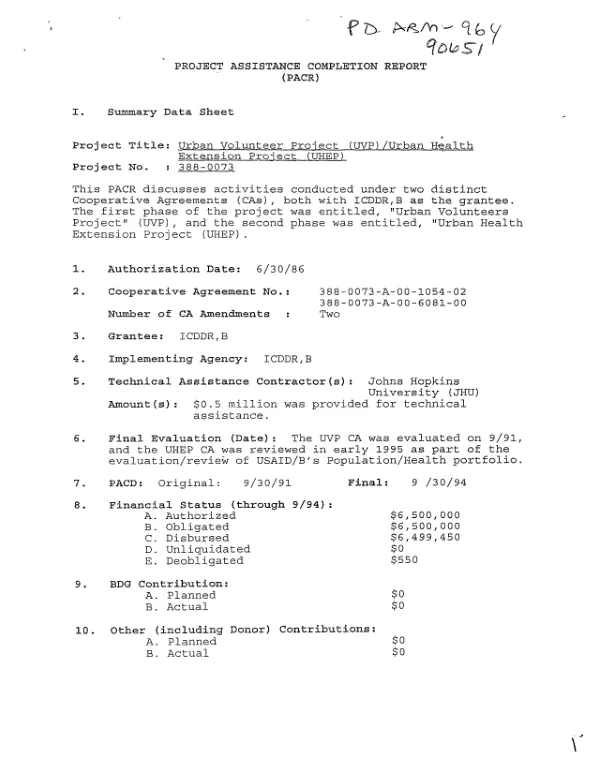
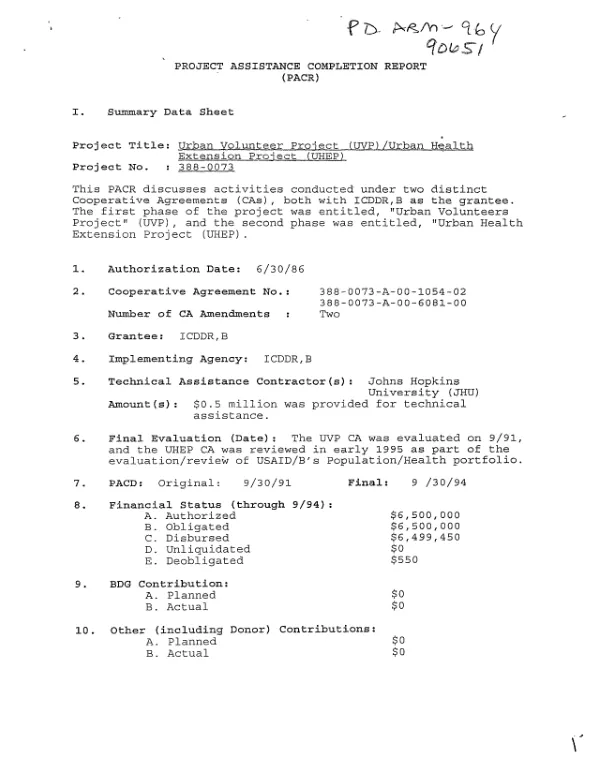
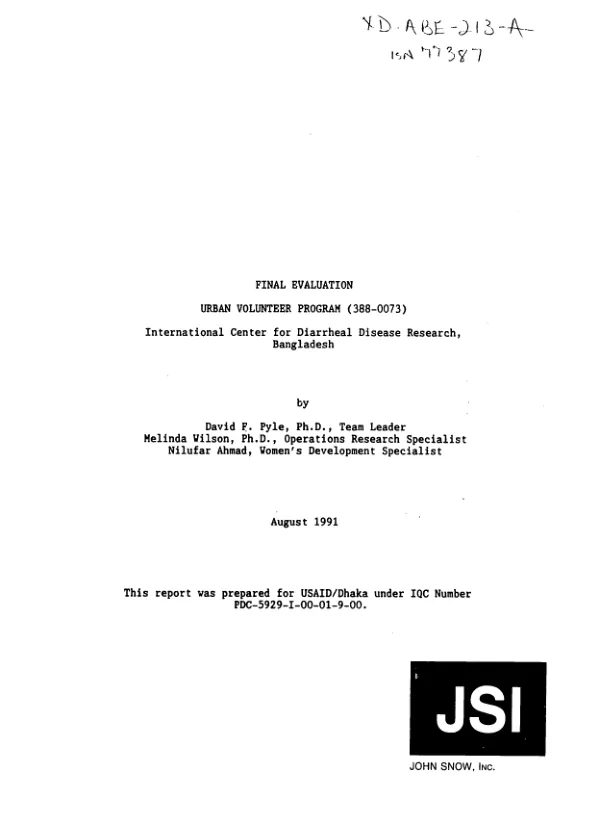
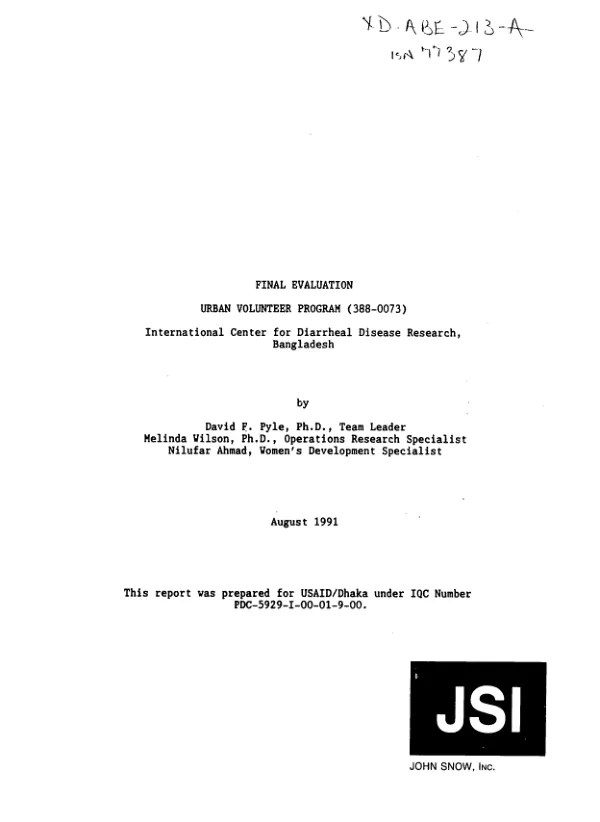
Project assistance completion report (PACR) : urban volunteer project (UVP)/urban health extension project (UHEP) -- 388-0073
Sign inUSAID. MISSION TO BANGLADESH
Project assistance completion report (PACR) : urban volunteer project (UVP)/urban health extension project (UHEP) -- 388-0073
PACR of a project (6/86-9/94) to train urban volunteers to provide child survival services in the slums of Dhaka, Bangladesh.
1996
Sign in to readA free account is required to download.
Abstract
In its first phase, as the Urban Volunteers Project (UVP) (9/86-91), the project developed and tested the impact of a maternal child health and family planning (MCH/FP) service delivery model. In its second phase, as the Urban Health Extension Project (UHEP) (9/91-9/94), the project disseminated its findings and supported related TA to government entities and NGOs providing health and FP services in urban areas. Both phases were implemented by the International Centre for Diarrheal Disease Research (ICDDR). As a result of the project, over 1 million people residing in urban slums were provided for the first time with basic health, nutrition, and MCH/FP services; basic sanitation and diarrheal prevention; and the use of oral rehydration solution. The result is improved health conditions for the urban poor. ICDDR trained over 1,500 female volunteers from the slums to provide MCH/FP services to their neighbors, opening up a previously unexplored avenue of service delivery. ICDDR also developed and maintained a unique urban health and demographic surveillance system (USS) to conduct and evaluate research on the health conditions in the urban slums of Dhaka. Thanks to the USS, the Government of Bangladesh (BDG), donors, and service providers have available to them reliable information about the plight of Bangladesh"s urban poor, resulting in more informed policy and planning and a likely increase in donor activities for this target group. The following were lessons learned. (1) Qualitative and quantitative evaluations of the volunteer system revealed the feasibility of recruiting, training, and retaining illiterate and semi-literate slum women as health volunteers -- a significant project achievement. These women can serve as important links between professional health workers and slum dwellers and may help overcome barriers to service utilization, especially by women. However, it is not realistic to devise a full-fledged primary service delivery system based only on volunteers, however effective. It would be wiser to maximize their usefulness by linking them directly to a formal health service delivery program. (2) During focus groups, the female volunteers revealed that they felt their volunteering would increase their own standing and mobility within the community while providing the community with useful and important services. (3) Since 1987, the project has maintained two small nutrition rehabilitation centers in the slums of Dhaka to serve moderately malnourished children. Evaluation of data for 1 year on admissions to the centers and on 1 year of follow-up activity revealed that the high dropout rate of attendees rendered the centers ineffective. Project managers are now considering a home-based nutritional rehabilitation system. (4) Evaluations have shown that, beyond collecting demographic data on Dhaka"s urban slums, it is necessary to disseminate the data widely to policymakers and NGO personnel.
Related documents
![[USAID-Concern Worldwide Municipality Partnership Child Survival Program], Saidpur and Parbatipur Municipalities, Rajashi Division, Bangladesh : final evaluation report](https://covers.devme.ai/gen/4915.webp)