USAID DEC
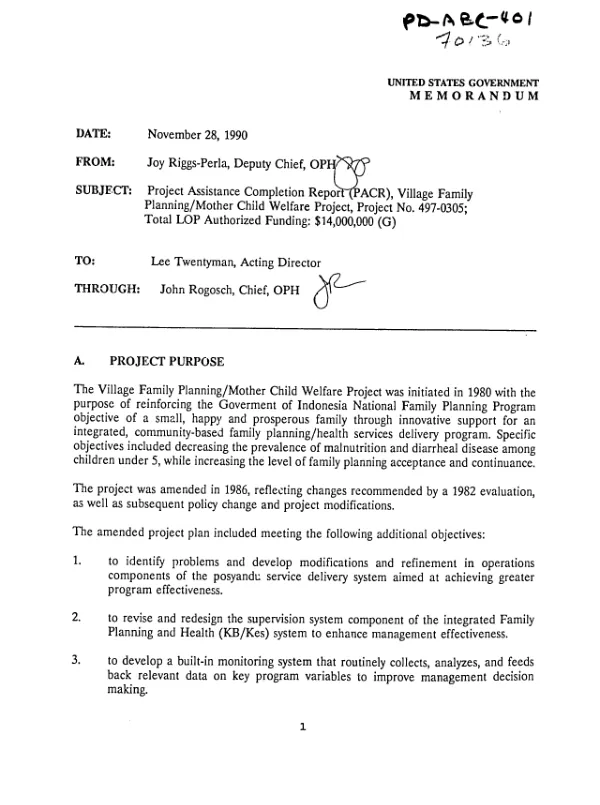
Project assistance completion report (PACR), village family planning/mother child welfare project
Sign inUSAID. MISSION TO INDONESIA
Project assistance completion report (PACR), village family planning/mother child welfare project
PACR of a project (1980-1990) to support community-based family planning and health service posts, or "posyandu," in Indonesia.
1990
Sign in to readA free account is required to download.
Abstract
For the first time, FP services were available at the village level, moving beyond the previous pattern of clinic-based services only. The number of posyandu increased from 90,000 in 1985 to more than 200,000 in 1990, although the quality of services is still variable. The project also funded 58 studies, far in excess of the 20 originally planned. Research activities helped shape the posyandu as a delivery model, provided opportunities for improving research skills, and, in some cases, influenced policy decisions. For example, the Government of Indonesia recognized its role in providing technical support for the posyandu while allowing villagers to take an active role in service development (e.g., through contributing space, selecting staff, and promoting the services). On the negative side, the project lacked strong supervisory activities, due to a shortage of personnel and funding. In addition, the posyandu were underutilized by mothers and children, especially pregnant women. This was caused by the distance of the posyandu from homes, inconvenient schedules, boredom with the weighing routines, and a lack of comprehension of the child growth card. The problem of referring high-risk pregnancies was also a major obstacle. Traditional birth attendants made referrals as a last resort, often when the patient was in a critical condition. Possible explanations for this problem include lack of knowledge about the referral system, inability to identify a high-risk pregnancy, or a sense of failure in referring a patient. The project also needs more imaginative social marketing approaches. Although the posyandu is regarded as a community activity, there is confusion as to whether management and responsibility lie in the communities or in the Ministry of Home Affairs. In order to achieve self-sufficiency among the posyandu, a clear plan for transferring responsibility to the village must be developed. Several lessons were learned. (1) The project's integrated task force structure was useful in directly linking researchers with policymakers and program managers and in establishing priorities to guide researchers. (2) Data flow and feedback to the village leaders on the results of posyandu service needed to be strengthened. (3) The training strategy, under which staff from higher administrative levels were responsible for training their subordinates, was only partially successful. Future training should concentrate more on specific identified problems. (4) The most serious problem remains the shortage of professionals in the sub-health centers, which link to the posyandu.
![Final evaluation of RICHES [resources in community health education support] 2000](https://covers.devme.ai/gen/5554.webp)