USAID. BUR. FOR LATIN AMERICA AND THE CARIBBEAN. OFC. OF CARIBBEAN AFFAIRS
Project assistance completion report[ : primary curriculum project]
Project Assistance Completion Report on a project (FY79-87) to improve the primary school curriculum in Eastern Caribbean countries.
1988
Sign in to readA free account is required to download.
![Project assistance completion report[ : primary curriculum project]](https://covers.devme.ai/gen/10095.webp)
Abstract
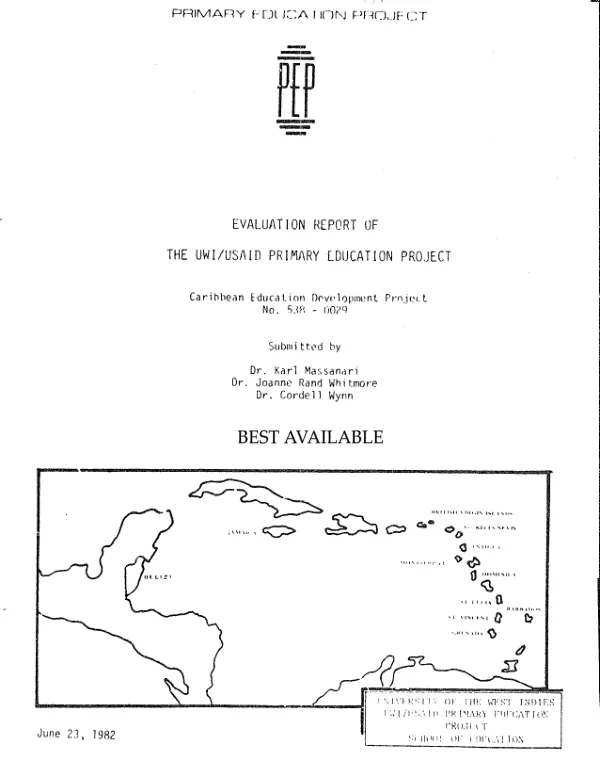
It was expected that ten countries would participate fully in the project. However, Grenada withdrew during the first year of project implementation and only rejoined following the U.S.-led intervention in that country in 1983. It should be noted that by October, 1985, project implementation was completed in all countries except Grenada and that the last two PACD extensions were required to facilitate the completion of activities in that island. All project activities have now been satisfactorily completed. This project benefitted from three external evaluations, one in 1981, another in 1982 and a final evaluation in 1985. At the time of the last evaluation, project implementation was nearing completion in all countries except Grenada. The evaluation found that (a) new curricula and teacher and student materials had been developed and reproduced in low-cost format and disseminated to schools; (b) teachers from five pilot schools in each country (Grenada excluded) had become skilled in the use of new instructional materials, new methods of teaching, classroom testing and curriculum development techniques; (c) principals of the pilot schools had been trained in educational planning and administration; and (d) the grantee, the University of the West Indies (UWI), had enhanced its capability to assist Eastern Caribbean countries in their educational development programs. During the post-evaluation period, Grenada successfully completed a curriculum development and training program similar to that undertaken in the other Eastern Caribbean countries. Several important lessons were learned from this project. Two of the most significant ones are as follows. (1) In a regional project of this nature, full-time Local Coordinators should be used: In this project, unlike the Secondary Curriculum Project, Project Implementation Officers/Local Coordinators were employed on a full-time basis. Experience showed that this led to more efficient project implementation. (2) Local expertise should be used wherever possible. The extensive use of West Indian educators in every major aspect of project design, implementation and evaluation was, perhaps, the single most important factor which contributed to the success of the project. UWI satisfied all preconditions set out in the Grant Agreement and adhered to the special covenants. No follow-on monitoring responsibilities were stipulated in the Agreement. (Author abstract, modified)
![Project assistance completion report[ : primary curriculum project]](https://covers.devme.ai/gen/19295.webp)
![Project assistance completion report [: BIMAP component of regional development training project]](https://covers.devme.ai/gen/19294.webp)
![Project assistance completion report [: family planning, information, education, communication and training]](https://covers.devme.ai/gen/10093.webp)
![CARDI [Caribbean Agricultural Research and Development Institute]/UWI [University of West Indies] agricultural research and extension project : AID grant no. 538-0164 -- final evaluation report](https://covers.devme.ai/gen/7430.webp)