USAID DEC
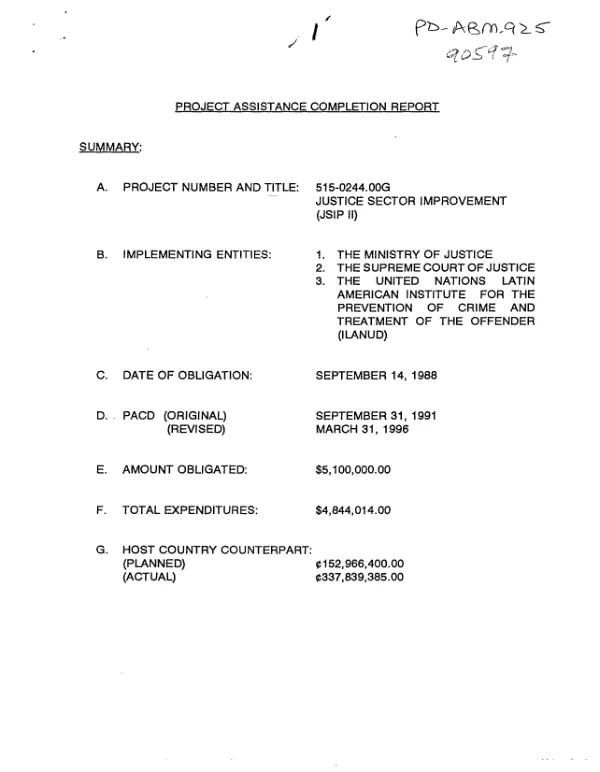
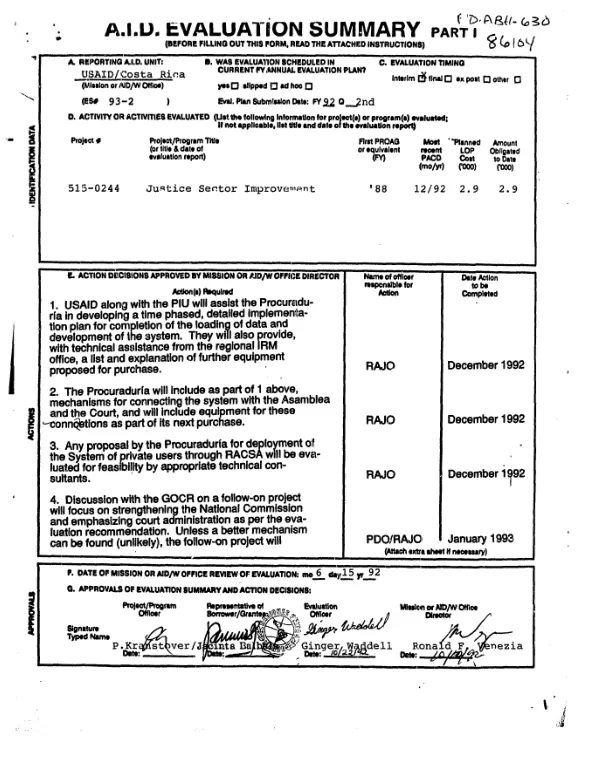
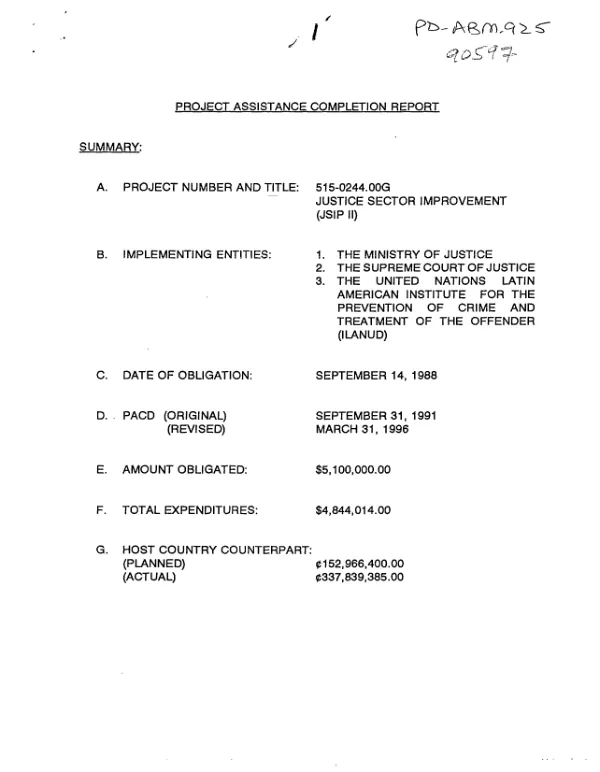
Project assistance completion report ; project no. 515-0244.00G -- justice sector improvement (JSIP II)
Sign inUSAID. MISSION TO COSTA RICA
Project assistance completion report ; project no. 515-0244.00G -- justice sector improvement (JSIP II)
PACR of a project (9/88-3/96) to modernize and consolidate the Costa Rican judicial system.
1996
Sign in to readA free account is required to download.
Abstract
All three project components -- Supreme Court administration, the National Commission, and the Judicial School -- were a success. Under the Supreme Court component, the project modernized judicial system administration by establishing 7 regional administrative offices in each province and a regional justice center that includes centralized clerk's offices, separation of judges from clerical staff to allow judges to focus on judicial work, and creation of professional administrator positions. The project also: conducted pilot projects in Perez Zeledon and Limon (to be replicated nationwide) to reduce caseload delay; introduced techniques for avoiding suspended judgements; streamlined procedures to give the Supreme Court better control over the management of cases in Salas III and IV; and established one of the first fully functioning community mediation centers in Central and South America, as well as an arbitration and conciliation center within the Chamber of Commerce. The project consolidated an organizational and operational model for the National Commission. The model takes into account the recently created Foundation for the Administration of Justice. The Commission developed a 5-year plan for justice sector reform, and a 5-year program and action plan for tackling priority reform areas; identified external funding sources and developed funding proposals; broadened its membership with representatives from other justice sector institutions; and explored mechanisms for funding its activities through the Government of Costa Rica budget (the Commission now receives core funding from the Ministry of Justice, the Supreme Court of Justice and Ombudsman). Finally, the project helped develop the Costa Rican Judicial School into a mature entity that conducts ongoing educational programs. Courses were developed and conducted in the areas of change management and adaptation; management and administration for judicial officials; improving the skills of judges in the writing of opinions; and International Commercial Law. The project's success is attributed, primarily, to the commitment and participation of the highest judicial officials; the project's clearly stated goals and objectives; competent professionals in charge of implementation; the periodic use of outside consultants to guide certain activities and/or conduct research, and having an ongoing external consultant with experience in similar activities; and the constant use of educational seminars to reinforce project activities.