USAID DEC
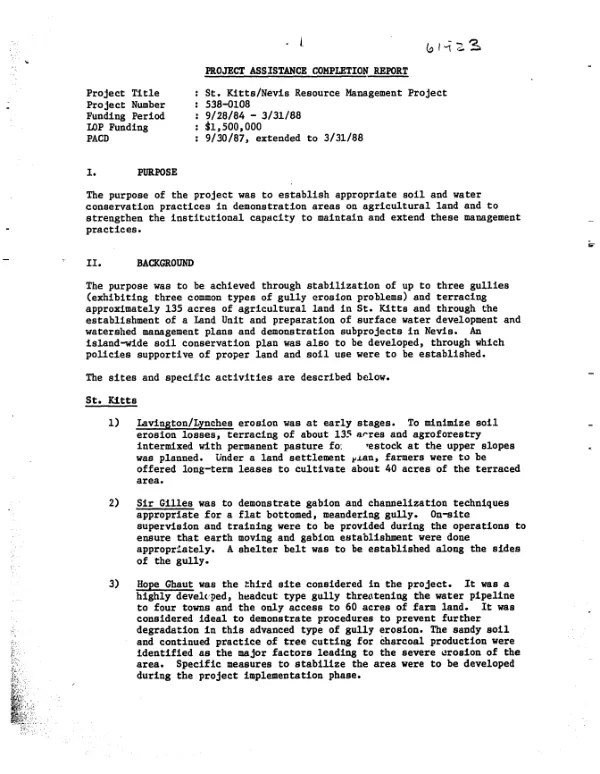
Project assistance completion report : project title, St. Kitts/Nevis resource management project
Sign inUSAID. BUR. FOR LATIN AMERICA AND THE CARIBBEAN. REGIONAL DEVELOPMENT OFC.
Project assistance completion report : project title, St. Kitts/Nevis resource management project
PACR of a project (9/84-3/88) to establish appropriate soil and water conservation practices on demonstration farms in St.
1989
Sign in to readA free account is required to download.
Abstract
Kitts-Nevis and to strengthen the indigenous capacity to maintain and extend these practices. The project achieved all targets for training of extension agents and science teachers and published soil conservation planning guides for both St. Kitts and Nevis. Site-specific activities on Nevis were highly successful. Though only 6-12 demonstration subprojects were planned, more than 20 were completed because of the strong interest and collaboration of the Nevis Ministry of Agriculture (MOA) and Nevisian farmers. Follow-up and maintenance on these activities - the vast majority of which involved water storage for agricultural purposes - were also encouraging. On St. Kitts, however, the project was characterized by abrupt changes of personnel, equipment misuse, and policy decisions that ran counter to the intent and conditions of the project design. For example, efforts to develop a small farmer land settlement and food crop production activity were blocked from implementation on two different sites by the MOA/St. Kitts. A primary reason for the lack of progress on St. Kitts was that a major project participant, the National Agricultural Corporation (NACO), merged with the St. Kitts Sugar Manufacturing Corporation (SSMC) early in the project. Although SSMC was to assume all of NACO"s responsibilities, hindsight shows that the sugar business took priority. A major weakness of the project was its inability to facilitate the development of supportive conservation legislation, policies, and regulations. As a result, the conservation activities conducted by the project lack the legislative basis for institutionalization. Thus, while the demonstration activities may be sustained with proper maintenance, the duplication of these practices throughout the country will depend on host government priorities and financial resources. Another lesson is that decisions on project extensions with concurrent TA contract extension should be weighed carefully in the light of host government capacity. In this case, when the PACD (but not the TA contract) was extended for 6 months, work effectively closed down with the departure of the TA team, especially on St. Kitts. The project also showed that what is successful on Nevis will not necessarily be successful on St. Kitts.
![Project assistance completion report [: soil conservation]](https://covers.devme.ai/gen/9920.webp)